
Digital wellbeing isn’t about rejecting technology or achieving some impossible balance. It’s about building rules that protect your life from tools designed to consume it. This is what I learned after years of failed attempts—and what finally worked.
I like technology. Really, I genuinely do.
I like mechanical systems, well-designed devices, and tools that solve real problems without creating new ones. What I don’t like is how easily technology use becomes unexamined—how it quietly takes over your life because you never decided what role it should play.
For years, I operated without those decisions. I used technology the way most people do: constantly, reactively, and without any real structure. And it made my life worse in ways I couldn’t fully articulate at the time.
This post isn’t about digital minimalism as an aesthetic. It’s not about productivity hacks or morning routines that look good on Instagram. It’s about what digital wellbeing actually means when you’re living through comparison, distraction, and the quiet erosion of time you’ll never get back.
And it’s about what finally worked after years of trying to fix it.
When Instagram Became a Daily Reminder That I Wasn’t Enough
Instagram was where I spent most of my time online. And every time I opened it, it felt like someone was throwing my failures in my face.
I’d scroll through beautifully curated homes—clean, minimalist, perfectly styled—and then look around at my own house. Lived-in. Cluttered. The reality of raising a toddler in a small apartment with limited storage and a husband whose hunting and fishing gear takes up more space than we have.
I’d see women with flat stomachs, perfect skin, coordinated outfits. And I’d look down at my own body—still carrying weight from a surprise pregnancy, still trying to figure out how to feel like myself again.
I’d see people my age building careers, launching businesses, traveling, thriving. And I’d think about my own timeline: two major career interruptions, another pause after my son was born, financial stress that limited every choice I wanted to make.
Instagram is a highlight reel. Everyone knows that. But knowing it intellectually doesn’t make it hurt less when you’re comparing your behind-the-scenes reality to everyone else’s polished final cut.
Every scroll reinforced the same message: You’re behind. You’re not doing enough. You should have done things differently.
And the worst part? I kept going back. Hours every day. Knowing it made me feel worse. Knowing it wasn’t helping. But unable to stop.

The Failed Attempts: 2022-2025
I tried to quit social media multiple times between 2022 and 2025. And I failed. Repeatedly.
The first time I tried, I didn’t take it seriously. I thought I could just… use less. Cut back. Be more disciplined. I didn’t delete anything and I didn’t change any systems. I just told myself to “scroll less” and expected willpower to do the rest.
It lasted maybe three days.
The second time, I tried creating rules without doing a digital detox first. I thought I could skip the hard part and go straight to moderation and set limits. I tried to use apps “mindfully” and told myself I’d only check Instagram once a day.
But I was still operating from the same addicted state. My nervous system was still wired for constant stimulation. The rules I created weren’t based on clarity—they were based on denial. And they fell apart within a week.
Over three years, I tried at least half a dozen times. Each attempt lasted longer than the last, but none of them stuck. And each time I went back, I felt worse—not just because I’d failed again, but because I was starting to believe I couldn’t change.
September 2025: What Finally Worked
In September 2025, something shifted. I’d been reading more about digital wellbeing—actual experiences from people who had successfully reduced their screen time and kept it off. I started researching the symptoms of excessive digital use and realized that things I’d attributed to chronic anxiety or fatigue were likely being caused, or at least worsened, by how much time I was spending online.
But I was a mother now and I wanted to build something meaningful. I wanted my son to grow up seeing a parent who was present, not distracted. And I wanted to stop wasting years of my life scrolling through other people’s highlight reels while my own life passed by unnoticed.
So I committed to a real digital detox. Not a half-hearted attempt. A full reset.
I don’t remember if it was a full 30 days—I think it was closer to two weeks—but it was long enough. Long enough to break the compulsion and see clearly. Long enough to realize how much of my life I’d been giving away.
And in that first week, something unexpected happened: I had the idea for After Scroll.
I was sitting in the quiet—the real quiet, not the fake quiet of scrolling in silence—and I thought: People need to know this. Especially people my generation.
I’m a millennial, born in 1991. I don’t know what it’s like to be an adult without digital technology. Actually, I don’t even know what it’s like to be a teenager without it. I got my first smartphone when I was around 15.
My generation was the first lamb to the slaughter. Our parents, born in the ’60s, had no idea what the dangers were. The internet was new. Social media didn’t exist yet. We were given unlimited access because no one knew better.
Gen Z, born after 2000, grew up fully digital—but their parents had already seen what it did to us. There was at least some awareness. Gen Alpha, the kids being raised now, have parents who are starting to set screen time limits, restrict devices, and think critically about tech use. It’s becoming mainstream.
But millennials? We were the experiment. And most of us are still living with the damage.
After Scroll was born from that realization. This isn’t just my story. It’s the story of an entire generation that was never taught how to protect itself.
The Rules That Actually Worked
After the detox, I didn’t go back to the way things were. I built systems and concrete structures that made misuse harder by default.
Rule 1: Social media apps deleted from my phone. Permanently.
I didn’t “limit” them or set daily timers. I removed them entirely. If I needed to check something, I could do it from my computer. But the friction was enough to break the compulsive loop.
Rule 2: My phone lives in a wallet-style case on top of the freezer.
Not on my desk or my pocket. Not within arm’s reach. On the freezer. If I need it, I have to get up and go get it. That small barrier eliminates 95% of mindless pickups.
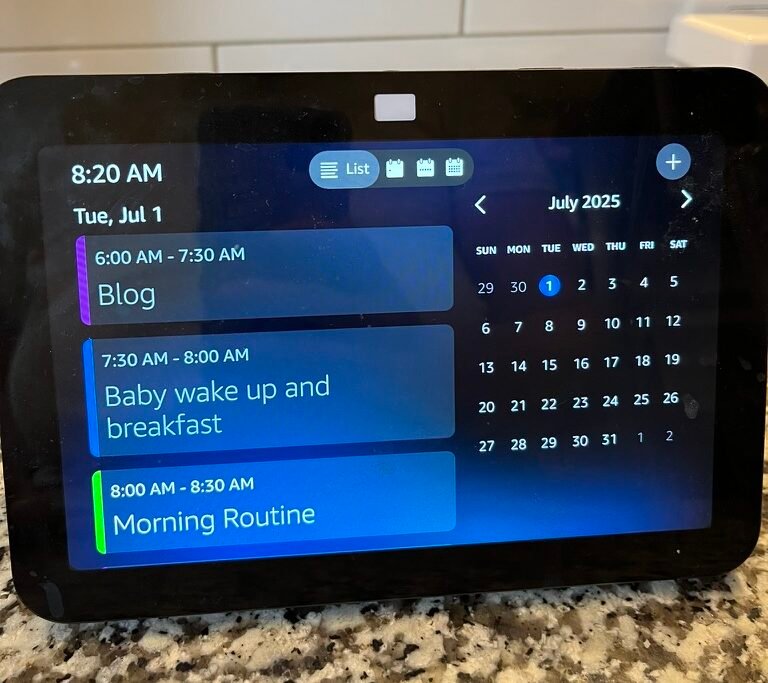
Rule 3: Echo Show handles everything that used to justify phone use.
I bought an Amazon Echo Show for my kitchen. Every morning at 8 a.m., it reads my calendar appointments out loud. If I need to check the weather, I ask the Echo. If I need to do a quick calculation, I ask the Echo. And if I need to see what time a store closes, I ask the Echo.
The Echo Show has a calendar screen and a planner interface. I can glance at my day without touching my phone or opening my computer. And crucially, there’s no feed. No notifications. No temptation to “just check one thing” and lose 30 minutes.
I sent my mom an Echo Show about two months after I started my detox. When we want to talk, we call each other through the device. And it’s perfect, because there are no feeds and no distractions. Just a functional piece of technology that does exactly what it’s supposed to do—and nothing more.
Rule 4: Boox Go 10.3 for planning and creating. Computer for execution only.
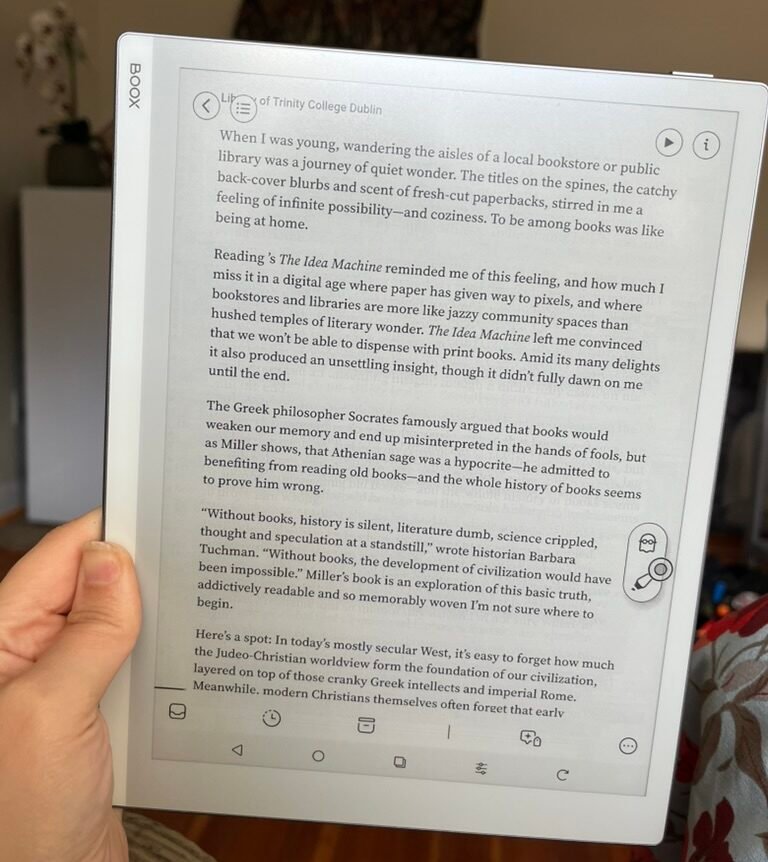
I bought a Boox Go 10.3 e-ink tablet a few months into this process, and it became one of the most transformative tools I’ve added.
E-ink screens don’t trigger the same compulsive behaviors as traditional screens. No color. No artificial blue light. And no visual noise. It’s designed for reading, writing, and thinking—not for scrolling or multitasking.
Now, my Boox is where I plan, brainstorm, draft, and organize. My computer is strictly for execution: publishing posts, editing images, managing platforms. That separation alone has dramatically reduced distraction and mental fatigue.
Rule 5: Computers stay off during non-work hours (mostly).
I try to keep my computer usage limited to work hours. But I’ll be honest: this is the rule I struggle with the most.
The computer is still a risk. Without social media on my phone, the computer becomes the next weak point. And every month, I notice I’m using it a little more than I should. So I readjust. I tighten the rules for a week. I pay attention to when I’m reaching for it out of habit instead of necessity.
This is the reality of digital wellbeing: it’s not a one-time fix. It’s ongoing maintenance.
The natural trajectory of technology use is always more. The inertia pulls you toward more screen time, more distraction, more noise. You have to actively resist that pull, and you have to do it consistently.
What Digital Wellbeing Is Not
Digital wellbeing is not “balance.” Balance implies that a little bit of everything is fine. But some technologies don’t need moderation—they need elimination.
If a tool consistently makes your life worse, using it “a little” isn’t balance. It’s just slower harm.
For me, Instagram was that tool. It didn’t entertain me. It didn’t restore me. And It didn’t connect me to anyone I cared about. It actually triggered comparison, anxiety, and a constant sense of inadequacy. There was no version of “just a little Instagram” that made sense anymore.
Digital wellbeing is also not productivity optimization. It’s not about using your time more efficiently so you can get more done. It’s about reclaiming your attention so you can actually live.
And it’s not about rejecting technology altogether. I love technology. I use it every day. But I use it with intention, structure, and clear boundaries that prevent it from consuming my life.
Why a Digital Detox Comes First
One of the most important ideas I learned from Cal Newport’s Digital Minimalism is that you can’t see clearly while you’re still stimulated.
When you’re constantly connected, everything feels necessary. Everything feels urgent. You can’t distinguish between what actually matters and what’s just noise.
A detox—whether it’s 30 days or two weeks or even just a few days—does two critical things:
First, it reveals what you genuinely miss and what you don’t. Most tools we believe are essential quietly disappear from our lives without consequence once we stop using them.
Second, it allows your nervous system to recalibrate. Constant digital stimulation keeps dopamine artificially elevated, which flattens motivation, creativity, and attention. Removing that stimulation creates space—sometimes uncomfortable space, but ultimately clarifying space.
For me, this was the moment I realized that “not having time” wasn’t real. I had time. I was just spending four to six hours a day on my phone.
The Question That Changes Everything
Here’s the question that reframed everything for me:
What is this technology for—and is it the best tool for that purpose?
Social media’s stated purpose is connection. But scrolling through feeds doesn’t connect you to anyone. It replaces genuine connection with passive observation.
My family lives on another continent. Staying in touch matters deeply to me. But Instagram never made me feel closer to them. Phone calls did. Video calls did. Direct messages did.
So the rule became simple: if the purpose is connection, the tool must actually support connection—not distract me from it.
This question applies to everything. If the purpose is entertainment, is endless scrolling the best way to be entertained? If the purpose is learning, is jumping between browser tabs the best way to learn? And if the purpose is planning, is doing it on the same device where you check email and watch videos the best way to plan?
Usually, the answer is no. And once you see that clearly, the changes become obvious.
What Digital Wellbeing Actually Means
Digital wellbeing is not about fear. It’s not about purity or rejecting modern life or living like it’s 1995.
It’s about clarity. And it’s about understanding what you want your life to look like—and choosing tools that support that vision instead of quietly undermining it.
Sometimes that means using technology differently or not using it at all. Sometimes it means investing in better tools—like e-ink devices, Echo Shows, or anything else designed with intention instead of addiction.
Less noise. Better rules. Clear purpose.
That’s the After Scroll approach.
Related Posts:
- How to Stop Scrolling (Complete Guide)
- Why Social Media Scrolling Feels Addictive (And What to Do Instead)
- Low Dopamine Morning Routine
- Morning Routine for Kids Without Screens
If you’re struggling with this, you’re not alone. Start with a detox. Build rules that actually work. And give yourself permission to admit when a tool simply doesn’t belong in your life anymore.