

Disclosure: This post may contain affiliate links. If you click and make a purchase, we may receive a small commission at no extra cost to you. We only recommend products we genuinely use, love, or believe align with the After Scroll philosophy.For a long time, I believed that a good morning routine checklist meant doing everything. Exercise, prayer, journaling, gratitude, a perfect breakfast, silence, intention — all before the day properly began. Everything felt important, which meant everything needed to happen at once, inside a very small window of time.
What I didn’t realize back then is that this way of thinking doesn’t create momentum. It creates paralysis.
When every area of life demands equal attention first thing in the morning, mornings stop feeling grounding and start feeling like a test you’re already failing before breakfast. I wasn’t overwhelmed by excess as much as I was stuck in the idea that nothing could be deprioritized. If it mattered, it had to happen. Every single day.
That understanding slowly changed, especially after reading The One Thing. Progress, real progress, rarely comes from doing more. It comes from identifying what actually moves the needle, and then organizing your environment so that your one thing isn’t constantly competing with noise, urgency, and decision fatigue.
That’s the mindset behind this morning routine checklist.
This is not a rigid routine. It’s not a productivity challenge. And it’s definitely not another list of habits you’re supposed to complete perfectly every day. It’s a tool designed to help you protect what matters most before the day starts pulling you in a hundred different directions.
What a Morning Routine Checklist Is (and Isn’t)
A lot of morning routines fail because they’re built on willpower. They assume you’ll wake up motivated, disciplined, and emotionally neutral every single day. That’s not how real life works.
This morning routine checklist is built around conditions, not discipline. It focuses on stabilizing energy, protecting attention, and reducing cognitive load so that doing your most important work doesn’t feel heavier than it needs to be.
It’s not about optimizing every minute of your morning. It’s about making a few upstream decisions that quietly shape the rest of the day. Some days, you’ll check a lot of boxes. Some days, only one. Both are fine.
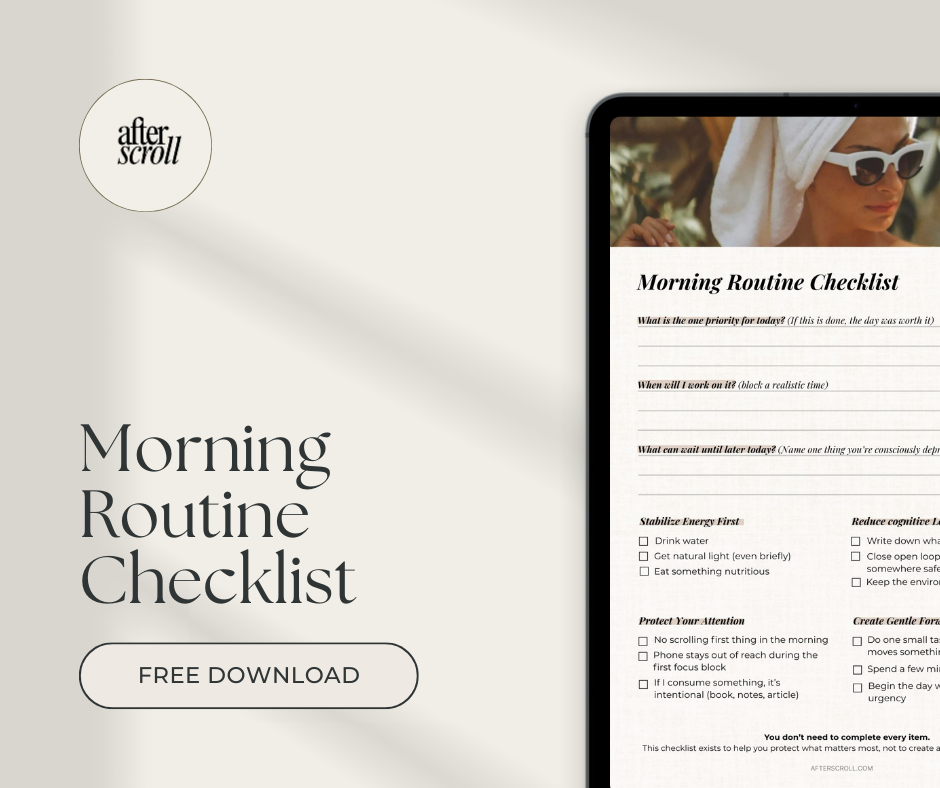
Start With One Clear Priority
At the top of this morning routine checklist, there’s one simple question: What is the one priority for today?
Not a to-do list. Not a vague intention. One concrete thing that, if done, would make the day feel worthwhile even if nothing else happened.
This matters more than any habit. When the day gets interrupted (and it will) knowing what actually matters keeps you from feeling scattered or reactive. It gives your day a direction, even if the plan changes.
Right below that comes a second question: When will I work on it?
Not “sometime today.” A realistic block of time. This is less about time management and more about honesty. Protecting your priorities starts with acknowledging how much time you actually have.
And then there’s one more quiet but powerful prompt: What can wait until later today?
Deciding what not to do is often more important than deciding what to do. This single step reduces mental clutter before the day even begins.

Why Doing Your One Thing First Changes Everything
Yesterday reminded me exactly why this morning routine checklist principle works so powerfully in real life.
I woke up around 7:00 AM, took a shower, made the bed, gave my son breakfast — the basics. But here’s what mattered: I scheduled my one priority at 8:00 AM. That priority was writing for the blog. By 9:30 AM, I had written, posted, and indexed the article in Google.
Then I took my son to the playspace nearby, a place where he plays with friends, takes some classes, and burns energy. It’s part of our routine, something important for him.
When we left the playspace, my son got hurt. Nothing serious, but it meant an unplanned trip to the doctor. Almost two hours of my day suddenly disappeared — time I hadn’t accounted for, attending to something that couldn’t wait.
And here’s the thing: it disrupted my day. Of course it did. But I felt completely calm. Because the most important thing was already done.
If I hadn’t completed my priority first thing in the morning, that doctor’s visit would have derailed everything. I would have spent the rest of the day feeling behind, trying to catch up, mentally carrying the weight of unfinished work.
Instead, even with the disruption, I felt grounded. The thing that actually moved the needle had already happened. That’s the power of using a morning routine checklist strategically. Not to create a perfect day, but to protect what matters most before life happens. And life always happens.
Some days are smooth. Some days bring emergencies you didn’t see coming. A structured morning routine checklist helps you build resilience into your day by ensuring your priorities don’t depend on perfect conditions.
Your priority doesn’t have to be professional. It could be related to your health, your relationship, your kids, your creative work. But whatever it is, do it early, while you still have control over your time, before urgency takes over.

Stabilize Energy Before You Optimize Anything
Focus is fragile when energy is unstable. That’s why the next section of this printable morning routine checklist isn’t about productivity at all. It’s about basics.
Drinking water. Getting a bit of natural light. Eating something that doesn’t spike and crash your energy. None of these are revolutionary ideas, but together they prevent your body from quietly working against you.
So much morning frustration comes from trying to think clearly on low fuel, dehydration, or overstimulation. You don’t need a perfect breakfast or a complicated routine here. You need enough stability to show up.

Protect Attention From Being Fragmented Too Early
Once attention is broken into pieces, it’s difficult to put back together. That’s why this morning routine checklist puts so much emphasis on what not to do first thing in the morning, especially scrolling.
Infinite feeds train your brain to jump, compare, and react before it has a chance to settle. Even a few minutes can shift your mental state in ways that linger for hours. Keeping your phone out of reach, delaying notifications, or replacing feeds with intentional input (like a book or notes you chose the night before) can make an outsized difference.
This isn’t about rejecting technology. It’s about deciding when it gets access to your attention.

Reduce Cognitive Load Before the Day Accelerates
A surprising amount of exhaustion has nothing to do with how much you’re doing and everything to do with how much you’re carrying in your head.
Writing things down. Closing open loops. Keeping your environment visually calm. Avoiding unnecessary decisions early in the day. These are small actions, but they lower the background noise that makes everything feel harder than it needs to be.
Clarity is not something you think your way into. It’s something you create by reducing friction.

Create Gentle Forward Motion
Not every morning needs to feel intense or highly productive.
Sometimes what matters most is movement, doing one small thing that clearly moves something forward. Reading a few pages of something that deepens your thinking. Spending a few minutes in silence. Stepping outside, even briefly.
The checklist ends with a simple reminder: Begin the day with intention, not urgency.
That intention doesn’t need to be dramatic. Sometimes it’s just a quiet acknowledgment of what you’re choosing to prioritize, and what you’re choosing to ignore.
How to Use This Printable Morning Routine Checklist
Print it. Keep it by your desk. Use it for a week, or pull it out on days when everything feels scattered. You’re not meant to complete every item. You’re meant to choose what supports the season you’re in right now.
This morning routine checklist exists to help you protect what matters most, not to create another impossible standard. When mornings stop competing with your priorities and start supporting them, momentum feels less forced. And from there, everything else tends to get a little easier.
Download Your Free Morning Routine Checklist
This printable morning routine checklist is designed to be simple, flexible, and realistic. It won’t ask you to wake up at 5 AM or complete ten habits before breakfast. Instead, it helps you:
- Identify your one priority for the day
- Stabilize your energy with simple, sustainable habits
- Protect your attention from digital distractions
- Reduce cognitive load before the day accelerates
- Create gentle forward motion without pressure
The goal isn’t perfection. It’s progress on what actually matters, even when life doesn’t go according to plan.
If this checklist was helpful, you may also want to read: Morning Routine for Success: 21 Habits That Actually Work — where I explain the thinking behind these choices and how to design mornings that protect what truly matters, even when the day doesn’t go as planned.
Ready to Take the Next Step?
Subscribe to The After Scroll newsletter for weekly insights, practical strategies, and honest reflections on living intentionally in a distracted world.