

Disclosure: This post may contain affiliate links. If you click and make a purchase, we may receive a small commission at no extra cost to you. We only recommend products we genuinely use, love, or believe align with the After Scroll philosophy.For the longest time, I thought being organized meant having everything under control. A color-coded planner, an elaborate system, and a morning routine list that looked impressive on paper but collapsed the moment life got messy.
I’d wake up with good intentions. I’d tell myself, today will be different. And then, within minutes, I’d be scrolling through my phone, reacting to emails, feeling pulled in ten directions before I’d even gotten out of bed. The day would start rushed, chaotic, and already behind. By the time I actually sat down to do meaningful work, I was exhausted from just trying to keep up.
What I didn’t understand then was that organization isn’t about doing more or being perfect. It’s about beginning the day oriented—knowing where you are, what matters today, and what can wait.
A morning routine list doesn’t exist to make mornings aesthetic or impressive. It exists to prevent the day from starting in reaction mode, in a mental scramble, or already feeling behind. These aren’t habits to turn you into a productivity machine. They’re simple, repeatable actions that reduce friction in the first hours of the day and quietly organize everything that comes after.
You don’t need all thirteen of these habits. You need a few that fit your life and that you repeat consistently enough that they become automatic. That’s when mornings stop feeling like a battle and start feeling like a foundation.

What Makes a Morning Routine List Actually Work?
Before we get into the specific habits, it’s worth understanding what makes a morning routine list effective versus one that just looks good on paper.
The best morning routine lists aren’t about adding more tasks. They’re about creating a sequence of small actions that:
- Reduce decision fatigue before your day even begins
- Ground your attention so you’re less reactive
- Create visual and mental calm that carries through the rest of the day
- Protect time for what actually matters instead of letting urgency take over
This is different from the morning routine advice that tells you to wake up at 5 a.m., meditate for an hour, journal three pages, work out, and then make a elaborate breakfast. That’s not a routine—that’s a performance. And for most of us living real lives with real constraints, it’s completely unsustainable.
What I’m sharing here is a morning routine list built for actual humans. Busy parents. Remote workers. People building something meaningful while juggling multiple responsibilities. People who need mornings to work with them, not against them.
My Morning Routine List: 13 Habits That Actually Organize Your Day
1. Open a Physical Planner Before Touching Your Phone
There’s something deeply grounding about starting the day with paper. A physical planner shows the day as it actually is—limited, concrete, and already shaped by commitments you’ve made. When you see your responsibilities laid out in front of you, it becomes harder to waste the first hour scrolling through feeds that don’t serve you.
The planner doesn’t judge or rush you. It simply reminds you that time exists and that it matters. That today has boundaries. That you get to choose how to spend the hours you have.
I keep my planner on my dresser, and it’s the first thing I reach for in the morning. Not my phone. Not email. Just a quiet moment with the day ahead, seeing it clearly before anything else pulls at my attention.
This single habit—opening a planner before touching your phone—has done more for my sense of control and calm than almost any other change I’ve made. It creates a buffer between sleep and reactivity. And that buffer is everything.

2. Ask One Grounding Question in Your Journal
Every morning, I answer the same question in my journal: What is the one thing that is under my control today that could make this a good day?
It sounds simple, but it sharpens your attention immediately. It shifts your focus from what might happen (anxiety) to what you can actually do (agency). It reminds you that even when life feels chaotic, there’s always something within your control that matters.
Some mornings, the answer is big: Finish the draft I’ve been avoiding. Other mornings, it’s small: Take a real lunch break. The size of the answer doesn’t matter. What matters is the act of asking yourself the question and writing it down.
Journaling doesn’t have to be elaborate. It doesn’t require three pages of morning pages or deep introspection. One question, one answer. That’s a morning routine list item you can actually sustain.

3. Take a Real Shower and Get Ready for the Day
This one feels almost too simple to mention, but it matters more than most people realize—especially if you work from home.
Staying in pajamas blurs the line between rest and responsibility. Getting ready—even when you have nowhere to go—signals a transition. It tells your brain: The day has started. We’re present for it.
I used to work in sweatpants and oversized t-shirts, telling myself it didn’t matter because no one could see me. But I could feel it. My focus was softer. My energy was lower. I felt permission to stay in “off” mode even when I needed to be “on.”
Now, I shower and get dressed every morning in clothes I wouldn’t be embarrassed to leave the house in. Not fancy clothes. Not uncomfortable clothes. Just intentional clothes. That small shift completely changes my mindset. I feel ready. And that feeling carries through the entire day.

4. Wear Clothes That Were Decided the Night Before
Decision fatigue starts early if you let it. Choosing clothes the night before removes one unnecessary decision from the morning and keeps things moving calmly. Mornings work better when fewer choices are required.
This doesn’t mean you need a capsule wardrobe or a specific aesthetic. It just means taking thirty seconds before bed to pull out what you’ll wear tomorrow. That’s it. One less thing competing for mental energy in the morning.
When your clothes are already decided, you don’t stand in front of the closet half-awake, trying on three different outfits, running late before the day has even begun. You just get dressed and move forward. Simple. Sustainable. Effective.

5. Do a Quick Bathroom Reset
This isn’t about deep cleaning. It’s about wiping the counter, straightening what’s visible, putting the toothpaste back, hanging the towel. It takes two minutes. Maybe less.
But walking into an orderly bathroom in the morning quietly steadies the mind more than we tend to admit. Visual clutter competes for attention even when we’re not consciously noticing it. A clean counter removes one small source of background stress.
I do this reset every night before bed so that morning me wakes up to a calm space. It’s a tiny gift I give myself—a small act of care that makes the next day just a little bit easier.

6. Make the Bed, Even Imperfectly
An unmade bed is a small open loop that lingers all day. Making it—even quickly, even imperfectly—closes the first cycle of the morning and creates a subtle sense of completion before anything else begins.
I’m not talking about hospital corners or decorative pillows. I’m talking about pulling the sheets up and smoothing the comforter. Thirty seconds. That’s all it takes.
But that small act of finishing something—anything—creates momentum. It tells your brain: We’re completing things today. We’re moving forward. And that feeling compounds throughout the morning.

7. Protect 10–15 Minutes of True Me Time
This matters more than it sounds. Ten or fifteen uninterrupted minutes in the morning—with coffee, soft music, silence, or simply your own thoughts—can anchor the entire day.
For me, this habit was essential during the most chaotic seasons of my life, and I’ve kept it ever since. When my son was a baby and mornings felt like pure survival, I still protected those fifteen minutes. Sometimes that meant adjusting the schedule. Sometimes it meant putting on a cartoon briefly. Sometimes it meant waking up just a little bit earlier.
It’s not indulgence. It’s regulation. It’s giving yourself a moment to land in your own body, in your own life, before the demands start. And that moment—that small pocket of peace—makes everything else more bearable.
A morning routine list that doesn’t include space for yourself isn’t sustainable. You need to be a person, not just a productivity system. And protecting those few minutes reminds you of that.

8. Use Sound Alerts for Non-Negotiable Commitments
Some things cannot be forgotten. Appointments, deadlines, fixed responsibilities—these deserve reliable reminders so you’re not carrying them in your head all morning.
Using sound alerts allows you to stay present without constantly checking your phone or mentally tracking time. You set the alarm and then you let it go. You trust that when the time comes, you’ll be reminded. That trust frees up mental space for everything else.
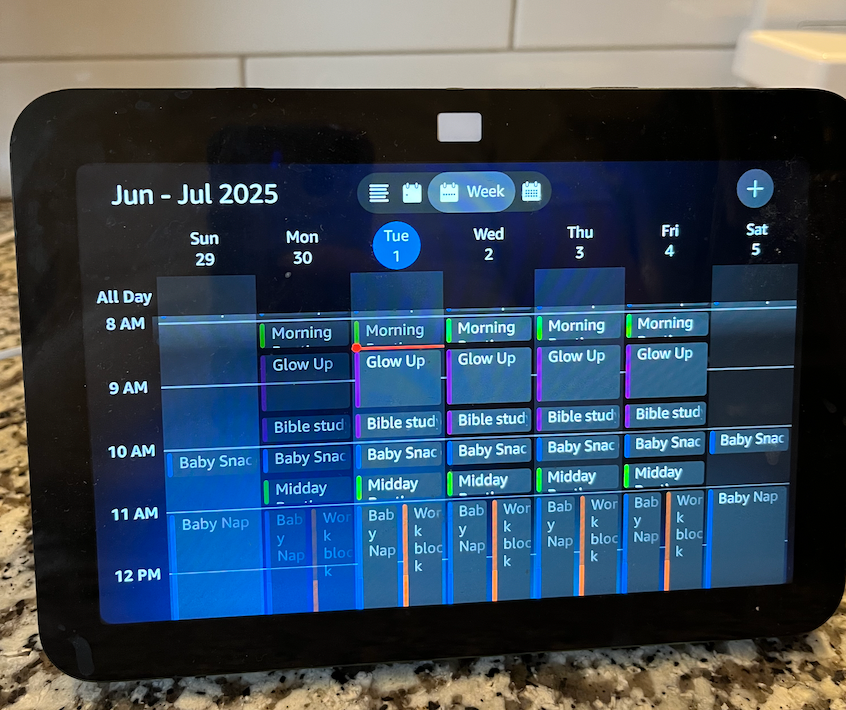
I use sound alerts from my Echo Show for anything time-sensitive: when I need to leave the house, when a meeting starts, when my son needs to be picked up. Without those alerts, I’d be checking the clock every ten minutes, half-distracted, unable to fully focus on anything. With them, I can be fully present until the alert tells me it’s time to shift.
9. Avoid the Phone Until You’re Oriented
The phone floods the mind with information before you’ve even placed your feet firmly in the day. Delaying it until after you’ve showered, written, planned, or sat quietly helps preserve mental clarity and prevents unnecessary urgency.
This is probably the hardest item on this morning routine list, and it’s also one of the most impactful. When I started delaying my phone for just the first hour of the day, everything changed. My mornings felt calmer. My focus felt sharper. I felt like I was starting the day on my terms instead of reacting to everyone else’s priorities.
You don’t have to delay it for an hour. Even thirty minutes makes a difference. The point is to give yourself a window of time where your attention belongs to you and only you.

10. Do a Five-Minute House Reset
Clear the counters. Load the dishwasher. Put things back where they belong. A small reset creates visual calm and removes background stress that quietly competes for attention throughout the day.
I do this reset after breakfast, before I sit down to work. It takes five minutes, sometimes less. But when I skip it, I feel the difference all day. The clutter nags at me. I notice it in my peripheral vision. It pulls at my focus even when I’m trying to concentrate on something else.
A clean space doesn’t guarantee a productive day, but a chaotic space almost guarantees a distracted one. This five-minute reset is one of the simplest ways to protect your mental bandwidth for what actually matters.

11. Do Your “One Thing” First
Your one thing is the work or responsibility that carries the most weight right now. The project that matters. The task you’ve been avoiding. The thing that, if completed, would make the entire day feel like a win even if nothing else got done.
Doing it in the morning changes everything. Anxiety drops because the hardest or most important task is already done. The rest of the day becomes lighter, more manageable, and less reactive.
For me, the one thing is always my blog. I protect the first 60–90 minutes of my workday for writing and publishing. Everything else—email, admin tasks, meetings—comes after. This isn’t because those other things don’t matter. It’s because if I don’t protect the one thing first, it never happens. Urgency takes over. And the work that actually moves my life forward gets pushed to tomorrow. Again.
If you take nothing else from this morning routine list, take this: identify your one thing and do it first. Everything else will still be there when you’re done. But this—this won’t happen unless you make space for it.

12. Work With Fewer Screens When Possible
When the task allows, choosing tools that reduce visual noise—writing linearly, limiting tabs, avoiding constant refresh—supports deeper focus. Organization isn’t only about time; it’s about attention.
I write my first drafts in a plain text editor with no internet connection. No tabs. No notifications. No ability to “just check” something. Just me and the words.
This isn’t always possible. Some work requires multiple screens and constant connectivity. But when you can create a low-stimulation work environment, it makes focus feel effortless instead of forced. And that difference compounds over hours and days.

13. Wake Up With a Gentler Alarm
A harsh alarm pulls the body into the day abruptly. A softer, more gradual wake-up can make mornings feel steadier and less rushed. It’s a small adjustment that can noticeably improve how the day begins.
Personally, I wake up with natural light. I don’t use blackout curtains, and the morning sun is usually enough to bring me out of sleep gently, without a jolt. That alone has made a noticeable difference in how my mornings feel.
For people who don’t have that option—because they need to wake up earlier, don’t have natural light in their bedroom, or sleep with blackout curtains—I’ve heard consistently good things about sunrise alarms. These alarms gradually increase light and sound over time, mimicking the way the sun rises and helping the body wake up more calmly instead of being startled awake.
This kind of change can sound almost too small to matter. But when you wake up feeling calm instead of rushed, you quickly realize that how you wake up sets the tone for everything that follows.

Building Your Own Morning Routine List
You don’t need to implement all thirteen of these habits at once. In fact, please don’t try. That’s a recipe for overwhelm and burnout.
Instead, choose one or two items from this morning routine list that feel most supportive for where you are right now. Practice them consistently for a few weeks. Let them become automatic. And then, if you want, add another.
The goal isn’t to have the most impressive morning routine. The goal is to have a morning that works—one that helps you start the day oriented, grounded, and present instead of rushed, reactive, and already behind.
A morning routine list doesn’t guarantee that everything will go smoothly. Life is unpredictable. Things will go wrong. Plans will change. But starting the day with a few simple, repeatable habits dramatically reduces the chances of beginning lost, overwhelmed, or scattered.
And in real life, that’s already a meaningful win.
When mornings become less about performance and more about presence—when they support your actual life instead of competing with it—everything gets a little bit easier. Not because you’re doing more, but because you’re finally protecting what matters most: your attention, your energy, and your ability to show up for the day you’re actually living.
If You Want Something Practical to Start With
If this way of thinking about mornings resonated with you, I created a simple Morning Routine Checklist as a starting point, not a “perfect routine,” but a grounded framework you can adapt to your real life. It’s meant to help you choose your own anchor habits, protect your energy, and stop overloading your mornings with things that don’t actually move you forward.
And if you enjoy this slower, more intentional approach to work, life, and the digital world, you might also like The Notes Edition, my Substack newsletter where I share behind-the-scenes reflections, essays, and quieter thoughts that don’t always make it onto the blog.
No noise. No pressure. Just notes, delivered straight to your inbox.