
Disclosure: This post may contain affiliate links. If you click and make a purchase, we may receive a small commission at no extra cost to you. We only recommend products we genuinely use, love, or believe align with the After Scroll philosophy.Screen-free hobbies aren’t just for kids. Adults need offline activities that restore attention, build skills, and provide satisfaction that scrolling never will. This guide helps you find hobbies that fit your life.
A year and a half ago, I went to a wedding with my husband. He was one of the groomsmen. I barely knew anyone there, our son was only six months old, and I was still very much living inside my phone.
At the table, another groomsman’s wife sat next to me. She was kind, clearly trying to make conversation so we wouldn’t just sit there in silence. We exchanged names, talked a little, and then she asked a simple, innocent question:
“So… what do you do for fun? What’s your hobby?”
And my mind went completely blank.
I knew my husband’s answer by heart. He hunts. He fishes. Not casually, not occasionally—it’s a way of life for him. He plans his days around it. He chooses it over sleeping in, over sitting on the couch, over comfort. That passion was something that had drawn me to him from the beginning.
But when it was my turn to answer, I had nothing. I suddenly realized I had slowly let screens replace everything. Scrolling had taken the place of hobbies without me even noticing.
I panicked and mentioned reading—something I used to love as a teenager, before social media rewired my attention. She followed up, naturally: “Oh, what was the last book you read?”
I couldn’t answer that either.
The only books that came to mind were the ones I’d read years earlier—Agatha Christie, Harry Potter—relics of a time when reading was still a real part of my life, not an abstract identity I clung to out of nostalgia.
I ended up deflecting, mumbling something about having a small baby and not having time for hobbies. The conversation moved on. She meant no harm. She was genuinely kind.
But I sat there feeling exposed in a way I hadn’t expected. I felt… empty.
That was the moment I realized I didn’t actually have a life outside of screens. No practice. No skill I was building. And no activity I returned to with intention or consistency. Just consumption.
This post exists because I know I’m not the only one who has heard that question and felt the same internal silence.
Why Most People Don’t Have Hobbies Anymore
Most people don’t have hobbies anymore. They have screens.
Ask someone what they do in their free time, and the honest answer is usually: scroll, watch, or play something digital. Not because they love it, but because it’s easy. Screens require no setup, no skill, no commitment. You just open an app and let the algorithm decide what you consume next.
The problem isn’t that screens are entertaining. It’s that they replace activities that would actually make you feel better.
Real hobbies—screen-free hobbies—require effort. But they also provide something screens can’t: a sense of competence, progress, and tangible accomplishment.
This post isn’t about forcing yourself to do things you hate. It’s about finding screen-free hobbies that fit your actual life, energy level, and interests.
Why Screen-Free Hobbies Matter
Hobbies used to be how people spent their free time. You played an instrument, built models, gardened, cooked, read… These activities weren’t productive in the traditional sense—they didn’t make money or advance your career. But they made life richer.
Screens replaced that. And what we lost isn’t just “doing things with our hands.” We lost:
- The ability to focus deeply without interruption
- The satisfaction of improving at something over time
- The experience of creating instead of consuming
- A sense of identity beyond what we do for work
Screen-free hobbies restore those things. Not because they’re morally superior, but because they’re built differently. Hobbies require sustained attention. Screens fragment it. Hobbies build skills. Screens don’t.
How to Choose a Screen-Free Hobby (When Everything Feels Hard)
The biggest obstacle to finding a hobby isn’t time. It’s decision fatigue.
When you finally have free time, the last thing you want to do is figure out what to do with it. So you default to screens because they’re effortless.
Here’s how to make choosing easier:
1. Start with what you already enjoy (even a little).
Don’t pick a hobby because it sounds impressive. Pick something that already interests you, even slightly. If you like food, try cooking. If you like being outside, try walking or gardening. And if you like making things, try woodworking or knitting.
2. Choose hobbies with low barriers to entry.
Don’t start with hobbies that require expensive equipment or extensive training. Start with hobbies you can begin immediately with minimal investment.
3. Accept that the first few attempts will feel awkward.
You will not be good at your new hobby right away. That’s the point. Hobbies are where you’re allowed to be bad at something without consequences.
4. Commit to trying for at least two weeks.
One session isn’t enough to know if you like something. Give it time. The first time I tried puzzles, I thought they were boring. By the third night, I was hooked.
Screen-Free Hobbies You Can Start Today
Creative Hobbies
1. Drawing or sketching.
You don’t need to be an artist. Get a sketchbook and a pencil. Draw badly. The goal is the process, not the product.
2. Painting.
Watercolors, acrylics, whatever. Follow along with tutorials if you want structure, or just experiment.
3. Writing.
Journaling, fiction, poetry, essays. Writing clarifies thought in a way that typing doesn’t.
4. Photography (without posting).
Take photos for yourself. Don’t edit them. Don’t share them. Just notice the world more carefully.
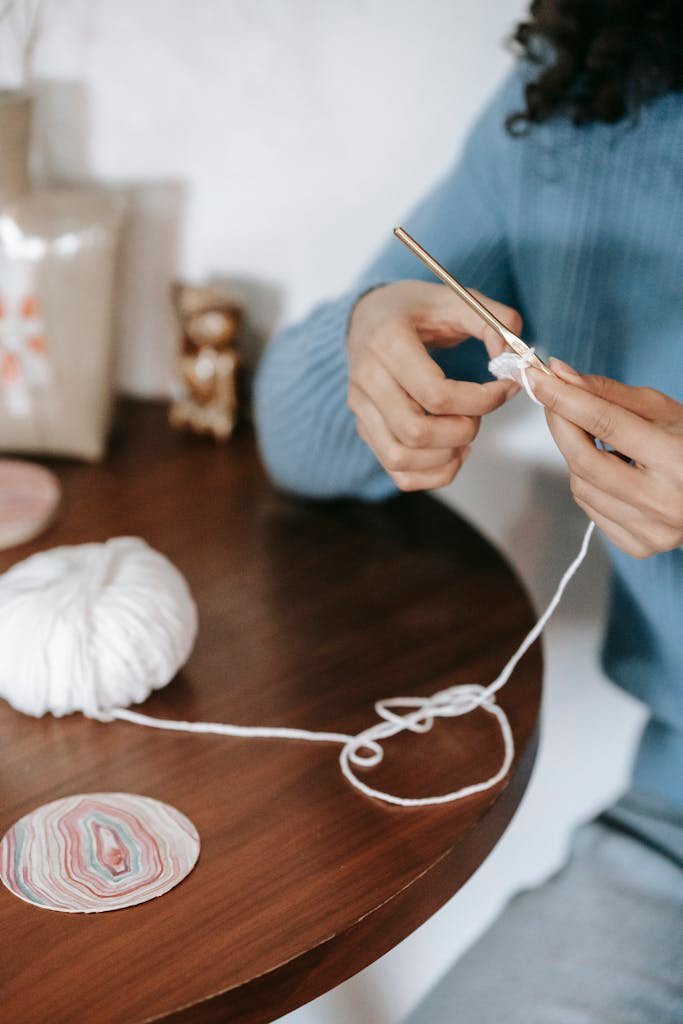
5. Knitting, crocheting, or sewing.
Repetitive, meditative, productive. You end up with something tangible.
Physical & Outdoor Hobbies
6. Walking (with intention).
Not exercise. Not “getting steps.” Just walking. Notice your surroundings. No headphones. No destination.
7. Gardening.
Even if you don’t have a yard, you can grow herbs on a windowsill. Gardening is slow, repetitive, and deeply satisfying.
8. Hiking.
Longer, more intentional than walking. Requires planning and commitment, which makes it feel purposeful.
9. Biking.
Movement, speed, exploration. Biking forces presence because you have to pay attention to the road.
10. Fishing.
Patient, quiet, focused. You’re outside, often alone, waiting. It’s the opposite of scrolling.
11. Foraging.
Foraging (mushrooms, berries, wild plants) requires skill, patience, and respect for the process.
12. Camping.
Disconnect completely. No Wi-Fi. No distractions. Just fire, food, and being outside.
Building & Making Hobbies
13. Woodworking.
Start small: cutting boards, shelves, simple furniture. Requires tools and space, but incredibly satisfying.
14. Model building.
Cars, planes, ships. Requires patience and precision. The process is meditative.
15. Cooking (not just meals, but experiments).
Try new recipes. Master techniques. Bake bread. Cooking is creation with immediate, tangible results.
16. Puzzles.
Jigsaw puzzles, crosswords, Sudoku. Puzzles are low-pressure, engaging, and screen-free. My husband and I usually do puzzles together with pizza on weekends.
Skill-Building Hobbies
17. Learning a musical instrument.
Guitar, piano, ukulele. Progress is slow but measurable. Practice feels purposeful.
18. Learning a language.
Duolingo doesn’t count (it’s a screen). Use books, flashcards, or language exchange meetups.
19. Chess or strategy games.
Physical board games. Chess, Go, checkers. Strategy games train patience and long-term thinking.
20. Reading (physical books).
Not audiobooks. Not e-readers. Paper books. Reading deeply without distractions is a skill we’re losing.
Social Hobbies
21. Joining a club or group.
Book clubs, running clubs, hiking groups, maker spaces. Social hobbies provide built-in accountability and community.
22. Volunteering.
Libraries, animal shelters, food banks. Purposeful, social, and grounding.
23. Board game nights.
Invite people over. Play games that require focus and interaction. No phones allowed.
What Stops Most People (And How to Push Through)
Obstacle 1: “I don’t have time.”
You do. You’re spending it on screens. Track your screen time for one week. You’ll find the time.
Obstacle 2: “I’m too tired.”
Screens feel restful, but they’re not. They drain attention without restoring energy. Real rest looks like reading, walking, or doing something with your hands.
Obstacle 3: “I don’t know what I like.”
Try five different hobbies. One will feel less annoying than the others. That’s your starting point.
Obstacle 4: “I’m not good at anything.”
Hobbies aren’t about being good. They’re about doing something for its own sake. Sucking at something is part of the process.
How I Found My Screen-Free Hobbies
I didn’t always have hobbies. For years, my free time was just… screens. Instagram, YouTube, endless scrolling.
When I finally pulled back, I felt restless. I didn’t know what to do with myself. So I tried things randomly:
- Puzzles (stuck)
- Crosswords (stuck)
- Walking without headphones (stuck)
- Reading (stuck so much I started a book clubs with friends)
Not all of them became long-term hobbies. But they filled the space where screens used to be. And over time, I started looking forward to them.
Now, my weekends involve puzzles with my husband, walking without my phone, and reading actual books. None of it is impressive. But it feels like mine.
Final Thoughts on Screen-Free Hobbies
You don’t need a hobby to justify your existence. But you do need something that isn’t consumption.
Screens are fine in moderation. But if they’re the only thing you do in your free time, you’re not relaxing—you’re just avoiding boredom.
Screen-free hobbies give you something to look forward to. Something to get better at. Something that’s yours.
Pick one. Try it for two weeks. See what happens.
If You’re Reading This, You Already Know Something Needs to Change
Finding screen-free hobbies is half the battle. The other half is creating an environment where you actually choose those hobbies over reaching for your phone.
If scrolling has become your default—not because you love it, but because it’s the easiest option—the problem isn’t willpower. It’s design.
Social media scrolling doesn’t feel addictive because you lack discipline. You’re addicted because it was designed to be ever-present, frictionless, and emotionally responsive, much like other modern dependencies woven into daily life. Once you understand that, the path forward stops being about guilt and starts being about systems.
If you want a grounded, complete framework for rebuilding your relationship with your phone—without quitting technology or relying on willpower alone—start here: How to Stop Scrolling (Complete Guide).
It walks through the specific steps that worked for me after years of failed attempts. Not tips. Not hacks. A system.
And if you want to explore this conversation more deeply, the After Scroll newsletter continues it quietly, one week at a time.