The most beautiful mornings have a certain kind of quiet authority. Light comes in. Water boils. The house is still becoming itself. Before messages, headlines, and other people’s moods arrive, you get a small stretch of time that still belongs entirely to you.
A screen-free morning routine helps protect that stretch. It gives your body a chance to wake up, your attention a chance to gather itself, and your day a clearer first chapter. Instead of handing the morning to a feed, you begin with your own life: your kitchen, your thoughts, your priorities, your people.
If you want this to work in real life, start with a few simple moves:
- give your phone a sleeping place outside your bed or outside your reach
- decide the first thing you will do before you look at any screen
- let light, water, and a little movement wake you up first
- keep one analog object nearby so your hands have somewhere else to go
- protect one short block of time for the thing that matters most today
That is enough to change the tone of a morning.
Start with a small screen-free window
The easiest version of this routine begins with a clear container. Choose the first 20 to 30 minutes of the day as your screen-free window and treat it like a protected room your phone does not enter.
This works because the goal is specific. Your morning does not need a heroic five-hour ritual. It needs one clean block where your attention can land somewhere solid before the internet asks for it.
A simple rule might be:
- no phone until I open the curtains, drink water, and look at my plan for the day
- no social apps until after breakfast
- no notifications until I finish my first priority block
If you want a deeper framework for a lower-stimulation start, it pairs naturally with a calmer first hour before the internet gets a vote.
Set up the night so the morning can stay screen-free
A good screen-free morning routine is usually built the night before. The morning feels easier when the environment has already made a few decisions for you.
A few high-leverage evening moves:
- put your phone on a charger outside the bedroom or across the room
- set out your coffee mug, water glass, vitamins, or walking shoes
- write down your one priority for tomorrow on paper
- leave your notebook, planner, or book already open to the right page
This is the same logic behind the night routines that quietly set up tomorrow: your future self wakes up inside conditions you created on purpose.
It also helps your sleep. The Sleep Foundation’s guide to how electronics affect sleep is a useful reminder that keeping the phone close late at night affects more than attention. It changes how your body settles too.
Give your body something to do before your brain goes online
One reason phones win in the morning is that they are immediate. They offer instant stimulation at the exact moment you still feel a little vague and unformed.
A screen-free morning routine works best when you replace that instant stimulation with a few physical anchors that feel easy and pleasant:
- Light — open the curtains, step outside, or stand by a window for two minutes.
- Water — drink a full glass before coffee if you can.
- Movement — stretch, walk the kitchen, step onto the porch, or take a short loop around the block.
These do not need to become a performance. They simply help you arrive in your body before you disappear into inputs.
Research from the Harvard T.H. Chan School of Public Health on why exercise boosts mood supports what many women already feel in practice: even short bursts of movement can shift your energy and make the rest of the morning feel more workable.
Replace the “check my phone” reflex with a three-step sequence
Morning habits become easier when you remove ambiguity. Instead of vaguely trying not to check your phone, decide what happens first every day.
Try this three-step sequence:
- Wake the room — open blinds, turn on one lamp, make the bed, or crack a window.
- Wake yourself — water, a quick stretch, a shower, coffee, or a two-minute walk outside.
- Wake the day — look at your planner and choose what today is protecting.
That third step matters most. In a simple printable plan for starting the day with more structure, the question is beautifully direct: what is the one priority for today? When you answer that before a screen gets involved, the morning already has a spine.
Quick phone checks feel harmless, but they fragment your attention faster than they seem to. APA’s explanation of switching costs is helpful here: every little mental jump makes focus more expensive. A screen-free morning routine protects your attention while it is still fresh and expensive in the best sense.
Make the first half hour physically interesting
Your phone often wins because it is the most stimulating object in the room. A screen-free morning routine becomes much more natural when the room itself gives you something better to land in.
Think about the first place you sit or stand every morning. What do your eyes meet first? What is within reach? What feels inviting?
A few small upgrades can change the feel of the whole routine:
- keep a real book, notebook, or printed checklist on the table where your phone used to go
- set one chair up as your morning chair, with a blanket or cushion that makes you want to stay there for ten minutes
- use one lamp instead of overhead glare so the room feels softer and more deliberate
- keep your phone in a fixed home, not wandering from bed to bathroom to kitchen with you
This is why making your phone less interesting on purpose works so well. It lowers the device’s emotional pull and gives real life a better chance to be chosen.
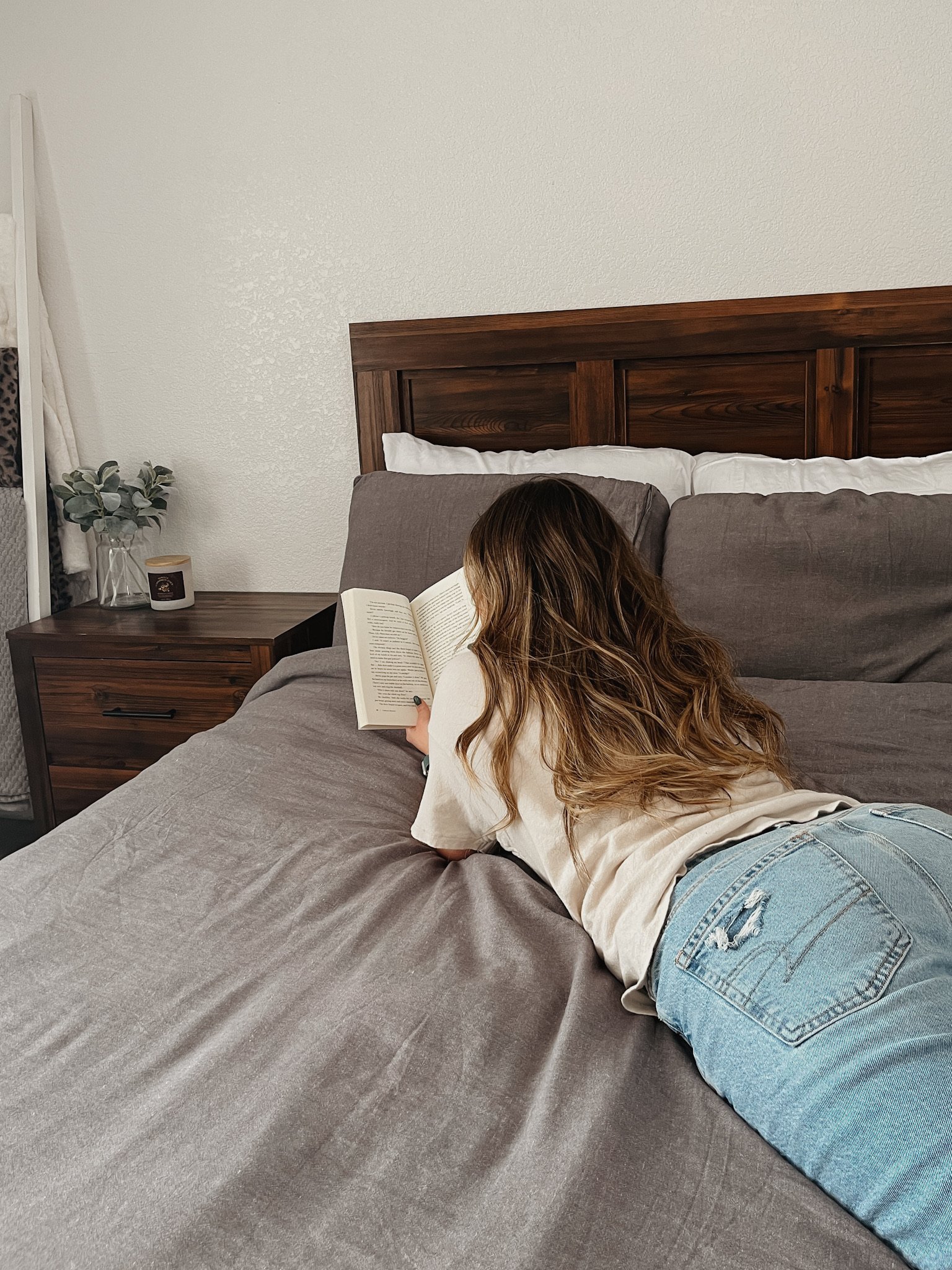
If you like the idea of a physical corner that gently invites you into pages instead of feeds, a reading space that feels easier to choose than scrolling offers the same principle in a more permanent form.
Decide what your screen-free morning is protecting
The point of this routine is not moral purity. The point is authorship.
A morning without a phone creates room for something more interesting to happen:
- one page of writing before work opens
- one short walk before everyone else needs you
- one calm breakfast at a table where nobody is half-scrolling
- one clear decision about what matters most today
- one quiet pocket of reading, prayer, journaling, or planning
When you know what your morning is for, it becomes easier to protect it.
Sometimes that purpose is structure. Sometimes it is focus. Sometimes it is giving your home a slightly more alive atmosphere before the day accelerates. Sometimes it is simply proving to yourself that your attention belongs to you first.
If you want more ideas for what can live in that space, browse a few realistic morning habits that actually hold up in daily life or a larger menu of screen-free activities that still feel genuinely appealing.
What a screen-free morning routine can look like in real life
There is no single ideal version. The best routine is the one that fits the life you actually live.
If you work from home
Keep the first 30 minutes screen-free, then use the next block for your one important task before Slack, email, or tabs start multiplying. A screen-free morning routine works beautifully when it protects creative work, planning, or the task that quietly moves your life forward.
If you have kids
Let the routine stay small and physical. Open curtains. Start breakfast. Drink water while they eat. Keep the phone on the charger and use paper for the day’s plan. A screen-free morning routine with children often works best when it feels more like atmosphere than a strict personal ritual.
If you commute
Use the first part of the morning at home to arrive before you scroll, then carry the principle into the commute. One page of a book, one note about the day’s priority, one walk to the train without opening social media still counts.
If your mornings are already rushed
Shrink the routine to five minutes:
- feet on the floor
- curtains open
- one glass of water
- one look at your plan
- phone stays away until that is done
Small still counts. Repeated small counts even more.
If you slip, restart the morning instead of abandoning it
Some mornings you will check your phone too early. The solution is not to declare the routine ruined. The solution is to restart the sequence.
Put the phone back down. Open the window. Drink the water. Return to your list. Do the next right physical thing.
A screen-free morning routine becomes powerful through repetition, not perfection. Over time, you start to notice the deeper change: the day feels less jagged. Your thoughts come together faster. Your home feels less like a backdrop for a device and more like a place where an actual life is happening.
That is the real promise here.
A screen-free morning routine gives the first part of the day back to the woman living it. It helps her build structure without heaviness, protect attention without drama, and begin from presence instead of reaction. The phone can come later. First, the morning belongs to you.