
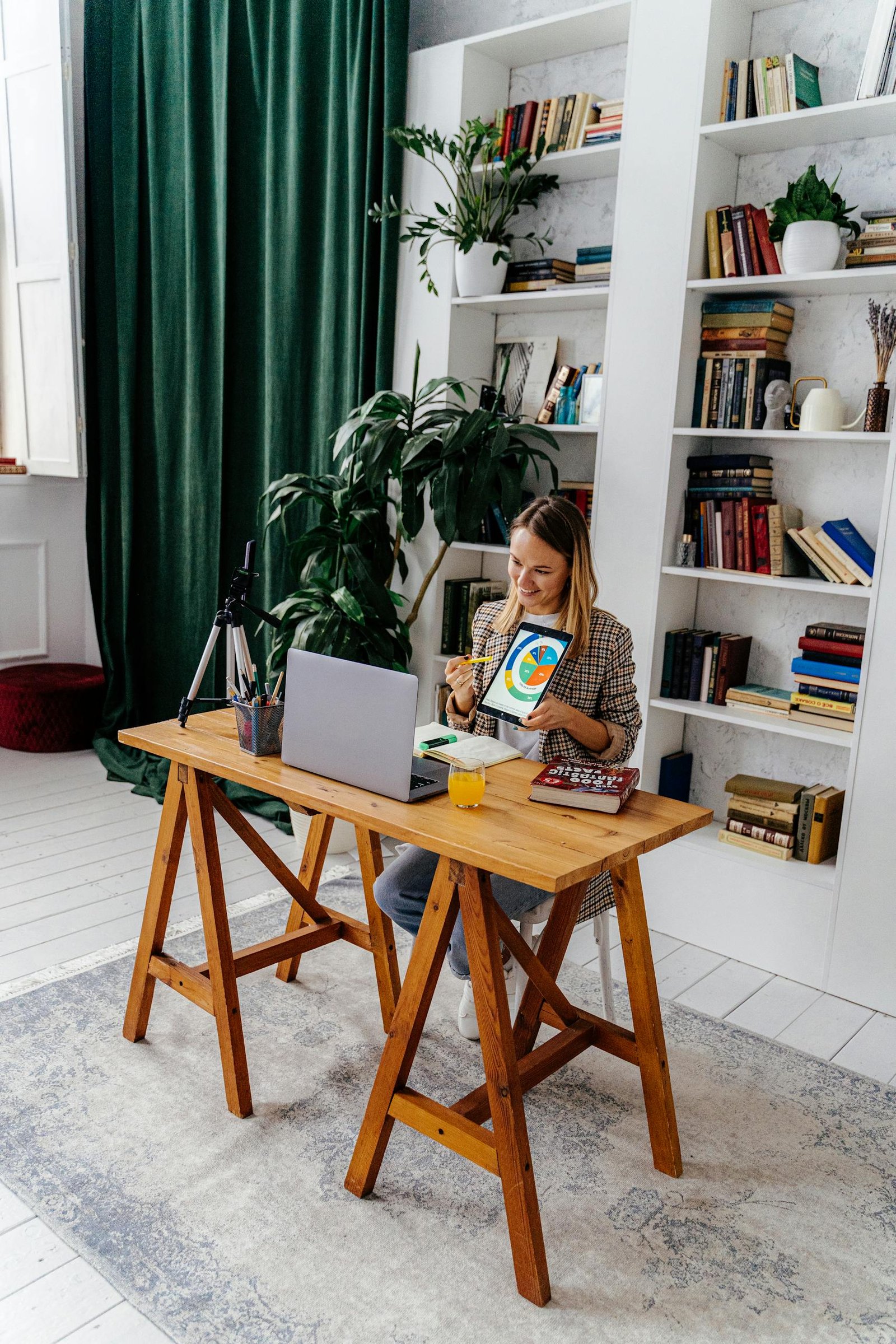
Learn how to structure a calm, productive work-from-home week with clear priorities, focused mornings, and simple rhythms that keep life moving forward.
Imagine a week at home that actually feels like it’s on your side.
Your laptop opens to the right project instead of ten tabs. Mornings have one clear job instead of twenty competing ones. Afternoons hold focused work and light admin in separate pockets. Evenings wind you down instead of pulling you back into your inbox.
Same responsibilities. Same kids, clients, Slack messages, and laundry. But by Friday, you can point to a few things that genuinely moved forward—at work and at home—without feeling like you sprinted through every hour.
Working from home makes this kind of week both easier and harder.
Easier, because you have more control over your environment and schedule.
Harder, because the lines between work, rest, and life blur until everything feels like one long, reactive scroll.
This guide is here to help you design a calm, intentional work-from-home week—with just enough structure to protect what matters most, and enough flexibility to hold real life.
Why Work-From-Home Weeks Need Their Own Structure
Office life has built‑in structure: commutes, office hours, meeting rooms, visual separation between “home” and “work.”
At home, everything shares the same space:
- Your most important project
- Slack and email
- Dishes, laundry, groceries
- Kids, partners, roommates
- Your phone, always within reach
Without a clear framework, your week quietly defaults to:
- Other people’s timelines (requests, DMs, emergencies)
- Maintenance tasks (housework, errands, admin)
- Frictionless distraction (phone, tabs, notifications)
You end up busy all week but strangely unmoved.
Posts like How to Structure Your Week So Life Actually Moves Forward reframe this: a good week isn’t the one where you did the most tasks. It’s the one where something meaningful—work, home, money, or your own growth—clearly moved.
When you work from home, that kind of week comes from deliberate rhythms:
- One or two priorities that quietly anchor the whole week
- Protected morning blocks before the day scatters
- Clear separation between deep work and admin
- Environmental cues that tell your brain “we’re working now” or “we’re home now”
You’re not chasing extreme productivity. You’re designing a week that feels grounded, generous, and genuinely effective.
Step 1: Give This Week One Clear Job
Most work‑from‑home weeks feel heavy because they’re secretly trying to carry ten “main things” at once—content, client work, house projects, appointments, parenting, finances, personal development.
A calmer approach is to give this week one unmistakable job.
Borrow the focusing question from The One Thing Book Review: Why Focus Beats Hustle Every Time:
“What’s the ONE thing this week can move such that, by doing it, everything else will feel easier or less necessary?”
Your answer might be:
- Finishing a draft or proposal
- Building one new system for your business
- Clearing a space at home so work feels easier
- Taking a concrete next step on a long‑term project
Write it at the top of your planner or digital calendar:
“This week moves forward: [one project, habit, or area of life].”
Then list 3 pieces of evidence you’ll see by Friday if that’s true:
- “I sent X email.”
- “I shipped Y deliverable.”
- “I reset Z space or system.”
This doesn’t mean nothing else happens. It simply means the rest of your tasks become supporting cast. Your week now has a spine.
Step 2: Protect a Morning Focus Block Before the Day Gets Noisy
In most homes, mornings are the clearest, quietest hours you get.
They hold:
- The fewest incoming messages
- The most fresh mental energy
- The least noise from everyone else’s agenda
If your most meaningful work only happens after the inbox, Slack, news, and group chats, it will always be competing with distractions.
A work‑from‑home week changes dramatically when you:
- Protect one focus block early in the day (even 45–60 minutes).
- Give that block to your week’s one thing.
- Delay your phone and inbox until that work is touched.
This is where frameworks like Low Dopamine Morning Routine: A Practical Guide to Starting Your Day Without Your Phone and Mindful Morning Routines to Try This Spring become deeply practical.
You don’t need an elaborate ritual. You need:
- A start time you can usually keep
- A phone that lives somewhere else for that hour
- A clear, finishable task waiting for you
Examples:
- 8:00–8:45 AM: outline the first two sections of tomorrow’s article.
- 9:00–9:30 AM: record one video for a course or offer.
- 7:30–8:15 AM: build the draft of a new client proposal.
When you work from home, those small wins are most available in the first quiet hour—before you hand your mind over to everyone else.
Step 3: Separate Deep Work From Admin in Your Calendar
Working from home can make every hour feel the same.
One minute you’re editing a deck; the next you’re answering DMs; five minutes later you’re ordering pantry staples or wiping the counter. Nothing is wrong with any of those tasks—but constant switching costs real energy.
To design a week that feels calmer and more effective, separate deep work from admin on purpose.
Think of your time in three categories:
- Deep work: writing, strategy, design, problem‑solving, anything that moves your one thing.
- Shallow work: email, Slack, filing, data entry, simple updates.
- Life admin: online orders, scheduling, quick calls, household logistics.
Then:
- Use your best energy hours (often mornings) for deep work blocks.
- Batch shallow work into 1–2 admin sessions per day.
- Give life admin its own contained window (for example, one “household power hour” per week).
Even in a small apartment, you can help your brain feel these differences:
- Deep work at a clear desk, with one tab or notebook open.
- Admin in a slightly different spot (or with different lighting), so it doesn’t encroach on your focus corner.
If you need inspiration for what finished deep work looks like in a week, How to Finish What You Start is a beautiful companion. The point isn’t to do everything. It’s to keep returning your best attention to a few things until they’re complete.
Step 4: Give Each Day a Gentle Role
Theme days can become overwhelming if you try to script every hour, but a gentle role for each day makes decision‑making much lighter.
For example:
- Mondays: planning + light creative work
- Tuesdays & Wednesdays: deep work blocks on your main project
- Thursdays: collaborative work, calls, and content reviews
- Fridays: admin, finances, and weekly reset
You’re not locking yourself into a rigid system. You’re simply:
- Reducing the mental load of “what should I do today?”
- Giving similar tasks a natural place to land
- Making sure your one thing appears several times across the week
This becomes especially helpful when your work‑from‑home life includes multiple roles—employee, freelancer, caregiver, creator, homemaker. A light theme per day makes it easier to see whether each role is getting enough attention across the week instead of trying to hold everything in your head.
Pair this with your weekly focusing question from Step 1, and your calendar quietly shifts from “a list of obligations” to “a structure that’s actively moving life forward.”
Step 5: Let Your Home Signal “Work” and “Off”
When everything happens in one space, your nervous system needs more help knowing when to be on and when to soften.
You don’t need a separate office. You need clear cues.
Draw from posts like The Case for an Analog Hour at Home and your broader home‑environment work:
- Create a simple work zone.
- One chair at the table.
- A tray that holds your laptop, notebook, and pen.
- A small lamp or candle you only use during focus time.
- Create an equally simple “off” cue.
- Close your laptop and put it back on the tray.
- Move the tray off the table.
- Turn off the lamp or blow out the candle.
- Give your phone clear roles.
- During focus blocks, it charges in another room.
- During breaks, you check it on purpose, not by reflex.
Posts like How Your Home Is Training You to Scroll and How to Create a Phone-Free Living Room You’ll Love show how small placement changes affect behavior. The same is true for work:
- If your laptop lives on the couch, work will leak into every free moment.
- If your work basket has a home and gets put away, evenings feel like evenings again.
You’re teaching your brain: here, we move things forward; there, we rest.
Step 6: Use Evenings to Make Tomorrow’s Morning Easy
Evenings are the hidden half of your work‑from‑home week.
What you do between dinner and bedtime quietly decides whether tomorrow’s morning feels like a rescue mission or a calm launch.
You don’t have to turn nights into a second shift. A few gentle habits from Evening Habits That Make Mornings Easier can change the entire feel of your next workday:
- Decide tomorrow’s one thing before bed.
- One concrete sentence: “Tomorrow will feel good if I move this forward.”
- Give tomorrow a 10‑minute home reset.
- Clear the surface you’ll work on.
- Load the dishwasher.
- Put a glass by the sink and your mug by the coffee machine.
- Choose one calming signal that says “the day is over.”
- A candle, softer lighting, a cup of tea, a short shower.
If you’re craving screen‑light evenings, borrowing the idea of an analog hour can help:
- 30–60 minutes after dinner where phones live in another room
- Light activities that restore you instead of draining you
When evenings hand your future self a tidy surface, a clear priority, and a calmer body, your next morning’s focus block becomes much easier to keep.
Step 7: Build a Ten-Minute Weekly Reset
A structured work‑from‑home week doesn’t need a complicated planning ritual. It just needs a small, consistent reset at the end of the week.
On Friday afternoon or Sunday evening, try:
- Look back.
- List three ways this week actually moved life forward.
- Notice where your one thing showed up—and where it got crowded out.
- Adjust the structure.
- Do your focus blocks need to move earlier or later?
- Do you need fewer theme days—or one new one?
- Is there a recurring task that deserves its own small slot instead of living in your head?
- Decide next week’s one thing.
- Use the same focusing question from Step 1.
This tiny review keeps you in a posture of active construction rather than passive survival. Your work‑from‑home weeks stop being something that just “happens to you” and start feeling like chapters in a story you’re writing on purpose.
Step 8: Let “Good” Mean Moving, Not Perfect
It’s tempting to judge a work‑from‑home week by:
- How empty your inbox is
- How tidy your house looks
- How many tasks you checked off
Those things matter, but they can also mask an uncomfortable truth: a perfectly managed week can still leave your life exactly where it started.
A better question at home is:
“What actually moved this week?”
Maybe you:
- Moved a project from idea to draft
- Clarified your offer and sent one brave email
- Created a morning block that now exists on your calendar
- Reset a room so it supports deep work instead of more scrolling
That’s structure doing its quiet job.
Your goal isn’t to perform the “perfect” work‑from‑home life. It’s to keep building a week that:
- Protects meaningful work before the day scatters
- Gives your body and home gentle rhythms
- Honors relationships and life admin without letting them swallow everything
Over time, that’s how you move from passively consuming your days to actively constructing a life you recognize.
You don’t have to overhaul everything this Monday.
Choose your one thing.
Give it a morning block.
Make one tiny change to your environment.
Then let this week prove to you what a calm, intentional work‑from‑home rhythm can do.