
Curious how 75 high-quality posts happened in just 3 months? Here’s the exact ClickUp system, weekly structure, and slow-productivity rules that made it possible.
Picture opening your ClickUp board on a quiet weekday morning and seeing row after row of tasks sitting in the Published column. Seventy-five finished posts in just three months — not because you “hustled harder,” but because your ideas had somewhere clear to land, grow, and ship.
That’s what this season of writing felt like for me. Less like a frantic sprint, more like a beautifully run production line for my brain. And the tool making all of it possible? ClickUp — a free project management app that became the quiet engine behind everything I publish at After Scroll.
If you’ve been meaning to get your content organized but keep circling back to a system that’s more complicated than your actual writing — this is for you. Because the gap between “I have so many ideas” and “I actually publish consistently” is almost never a creativity problem. It’s a systems problem.
Why most content creators stay stuck
Before I had a system that worked, my writing life looked like most people’s: an Airtable base that felt impressive on paper but demanded constant maintenance, ideas scattered across too many places, and a vague guilt that followed me around every time I saw someone else publishing consistently.
I’ve written about this in detail in Why My Airtable Blog System Broke (and ClickUp Didn’t), but the short version is this: I built a system for a team when I only needed a clear path for one very human brain. Multiple tables, relational fields, formulas, automations — all of it looked sophisticated and none of it made me want to write.
The problem wasn’t motivation. It wasn’t talent. It was that my ideas had no frictionless home — nowhere to flow easily from the moment of inspiration to the moment of publication. Every time I sat down to write, I was also doing the invisible work of navigating the system, remembering where I’d left off, and convincing myself the idea was still worth pursuing.
That invisible work is exhausting. And it’s the reason so many smart, creative women with genuinely good ideas never build the body of work they’re capable of.
The fix isn’t to work harder. It’s to build an environment where your ideas can’t get lost — and where the system is simpler than the work itself.
The ClickUp editorial hub that runs everything
When I started After Scroll, I gave myself one constraint: the system had to be lighter than the writing.
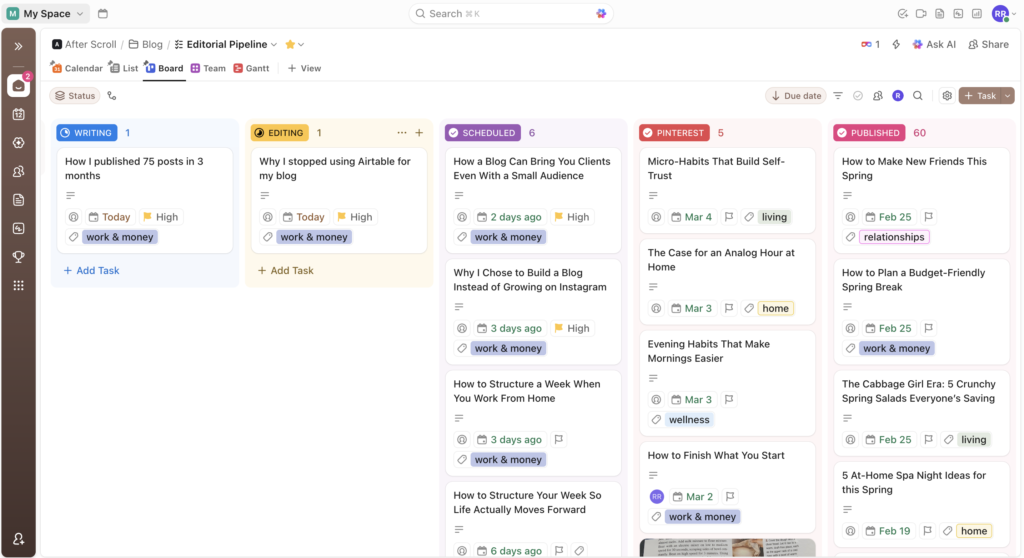
So instead of rebuilding another database, I opened ClickUp and created the editorial pipeline I actually needed. Every post starts as a single task that moves through a simple set of statuses:
- Idea – a spark, a phrase, a working title
- Backlog – ideas I’ve confirmed I want to write
- Writing – what I’m actively drafting
- Editing – shaping, cutting, polishing
- Scheduled – ready and lined up in the CMS
- Published / Optimize / Pinterest – the post is live and now part of the After Scroll ecosystem
One task per post. One place for the draft, the SEO title, the checklist, the canonical URL, and any future optimization notes. No extra tables to update, no separate views to maintain. The board itself tells me what to do next.
The result is that I can glance at the pipeline and instantly see the flow of my writing life — not just a pile of to-dos. I know exactly how many posts are in progress, which ones are almost ready, and what’s coming up next. There’s no mental overhead. The system holds it all.
I also lean on a small team of specialized AI agents who jump in for very specific tasks inside this system. Because every piece of information about After Scroll lives in ClickUp — the brand voice, the content categories, the SEO guidelines, the published posts — they can do their part incredibly well without long handovers or extra context. It’s the closest thing I’ve found to having a real editorial team, completely free.
The pace behind 75 posts (without hustle culture)
Publishing 75 posts in 90 days sounds intense, but it didn’t come from working until midnight or treating my life like a content factory.
It came from committing to slow, steady, intentional progress. The question was never “How much can I cram into a day?” It was:
What is the smallest repeatable unit of writing I can finish today?
Some days that meant writing a full draft. Other days it meant moving three posts from Editing to Scheduled, or spending an hour filling the Idea column with topics I was genuinely excited to write. Every small action moved the pipeline forward without burning me out.
Slow productivity is incredibly compatible with volume when your environment is set up well. A clear pipeline lets you keep saying yes to depth and quality while quietly increasing output in the background. You’re not sprinting — you’re just never standing still.
The other thing that made 75 posts possible was letting go of the idea that every writing session needed to feel inspired. Most of them didn’t. I opened ClickUp, saw what was next, and simply did the next right thing. The system removed the decision. I just had to show up.
How a typical week was structured
The other secret behind 75 posts is that I stopped asking my brain to do every kind of work every single day. Creative thinking, analytical editing, strategic planning — these are genuinely different modes, and switching between them constantly is one of the fastest ways to drain your energy and produce mediocre work.
Instead, my week was structured around one main creative focus at a time:
- Monday–Wednesday – Production days. Drafting, editing, scheduling. I outlined new posts, refined pieces from the day before, and pushed ready articles into Scheduled. These were my deepest work days — phone on Do Not Disturb, ClickUp open, nothing else.
- Thursday – Optimization day. A quieter, more analytical pass where I revisited recently published posts, checked internal links, tightened SEO basics, and added notes into the Optimize column for future updates.
- Friday – Research and topic creation. A light, future-focused day for reading, collecting ideas, and filling the Idea and Backlog columns with topics I was genuinely excited to write next. No pressure to produce — just to plant seeds.
Because I work from home, I’m constantly looking for rhythms that respect my actual life, not an imaginary productivity ideal. This structure gives each day a clear flavor so your brain knows exactly what kind of work it’s walking into. No decision fatigue. No blank-page paralysis. Just: it’s Monday, time to write.
Micro-rules that kept quality high
High volume can quietly erode quality if you’re not intentional about protecting it. I set a few gentle rules for myself that made sure the 75 posts I shipped were actually worth reading — not just filling space.
- Every post needed a clear promise. Before I moved anything from Idea to Writing, I had to answer: “What will change for her by the end of this article?” If I couldn’t answer that clearly, the idea went back to Backlog until it was ready.
- No publishing purely for the algorithm. SEO mattered, but a post still had to feel like something a real woman would genuinely want to read on a real Tuesday afternoon. If it felt hollow, it didn’t go out.
- One primary takeaway per post. Each article had one job — not seven. I wanted readers to finish a post and know exactly what to do differently, not feel vaguely informed about everything and moved by nothing.
- Internal links had to feel like invitations, not detours. When I linked to another post, it was because it genuinely deepened the moment for the reader — not because I was trying to hit a number.
These rules meant that even on weeks where I shipped the most, the work still felt aligned with After Scroll’s core philosophy: helping women move from passive scrolling to actively constructing the life they want.
Protecting focus from the scroll
One of the biggest reasons creative people don’t publish consistently is that their attention gets quietly siphoned off — usually before they even sit down to write.
Here’s what I did to protect my focus during this season:
- I created scroll-free writing blocks where the only open window on my screen was ClickUp and the draft. No tabs, no notifications, no “just a quick check.”
- I used my phone for inspiration capture only, not consumption. If an idea hit while I was making coffee or walking, it went straight into the Idea column — and then the phone went back down.
- I made publishing more satisfying than scrolling. Watching a task move from Writing to Published became its own quiet dopamine hit. The pipeline gamified consistency in the best possible way.
Because my ideas had a clear place to land, I didn’t need to hold them in my head or keep returning to scattered notes to make sure they were still there. They were safely parked in the system, waiting for their turn. That mental freedom is worth more than any productivity hack I’ve ever tried.
How to adapt this system to your own creative work
You don’t need to publish 75 posts in three months. That number was simply the natural result of a season where my environment, focus, and energy were all quietly pointed in the same direction.
What matters more is that you have:
- A single home for every idea, at every stage
- A simple set of statuses your work moves through
- A weekly rhythm that protects time for drafting, editing, scheduling, and optimizing
- A handful of personal rules that keep your quality and voice intact
From there, you scale the pace up or down depending on your season — a busy month, a slow week, a creative drought, a burst of inspiration. The system holds steady regardless.
The goal isn’t to publish more for its own sake. It’s to build an environment where your best ideas actually make it out into the world instead of dying quietly inside an over-engineered system you’ve stopped opening.