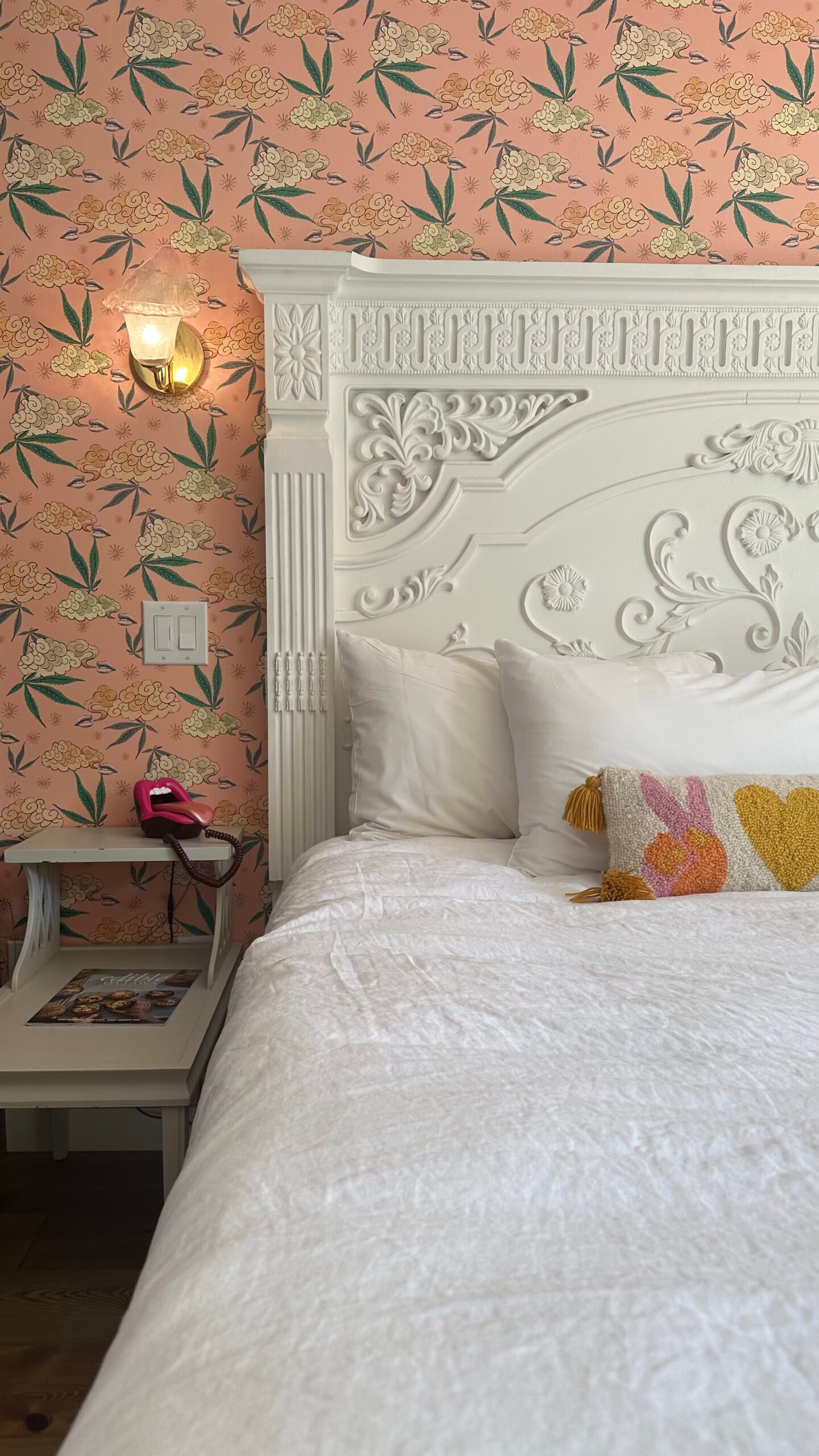
Turn your bedroom into a calm, screen-free sleep sanctuary with simple design tweaks, boundaries, and rituals that help your brain wind down instead of scroll.
Your bedroom is supposed to be the softest place in your home.
In reality, for most of us, it’s the place where we do our most committed scrolling.
You climb into bed exhausted, promise yourself you’ll go to sleep after “just one more,” and wake up the next morning wondering why you feel wired, foggy, and strangely resentful of the space that’s supposed to be your sanctuary.
In How Your Home Is Training You to Scroll, I wrote about the way whole rooms can quietly nudge you toward your phone. This post zooms into the most intimate room in your house—the bedroom—and shows you how to retrain it into a screen-free sleep sanctuary.
Not an Instagram-perfect setup with a $500 linen duvet and the perfect sconce.
A real bedroom that:
- Helps your nervous system downshift at night
- Makes it easier to put your phone away
- Supports deep, consistent sleep instead of fractured, scroll-filled nights
You don’t need a bigger space or a full makeover. You need a few clear rules, some gentle design tweaks, and a different story about what your bedroom is for.
Why Your Bedroom Keeps You Awake (Even When You’re Exhausted)
If your bedroom has quietly become your favorite place to scroll, it’s not a character flaw. It’s conditioning.
Over time, you’ve taught your brain:
- Bed = screen time. You scroll to “relax” at the end of the day.
- Pillow = portal. The moment you lie down, your hand reaches for your phone.
- Darkness = no witnesses. Late-night scrolling feels private, so it’s easier to ignore how long it’s been.
From a habit loop perspective, your bedroom is full of cues:
- The glow of the screen in a dark room
- The charger by the bed
- The muscle memory of lying down and opening an app
Every time you repeat that loop—bed → phone → feed → tiny dopamine hits—you reinforce it.
On top of that, there’s the biology:
- Blue light from screens suppresses melatonin, the hormone that helps you feel sleepy.
- Emotionally charged content (news, DMs, Reels) spikes your nervous system right before you’re asking it to rest.
- Rapid, fragmented input trains your brain to expect micro-stimulation instead of the slower, more boring process of falling asleep.
So when you tell yourself, “I should just be more disciplined,” you’re ignoring the fact that your room is currently designed to work against you.
The goal of a sleep sanctuary isn’t perfection. It’s re-training the room so that everything in it quietly points your body toward rest instead of toward another 45 minutes on your phone.
What a Sleep Sanctuary Really Is (Beyond Candles and Linen)
The internet has turned “sleep sanctuary” into a vibe: neutral bedding, a candle, maybe a eucalyptus branch.
Pretty? Yes.
Enough to undo years of bed-scrolling? Not really.
A true sleep sanctuary is less about aesthetics and more about clear jobs:
- The room has a job: rest and recovery.
- The bed has a job: sleep and intimacy.
- The nightstand has a job: hold what supports winding down, not what keeps you wired.
Everything else is optional.
If you’ve been following the arc from Why Your Home Became Beige (And Why It’s Time to Bring Life Back) to How Your Home Is Training You to Scroll, this bedroom post is the quiet next step. It’s not about making your room emptier. It’s about making it rich in the right kinds of signals:
- Light that tells your brain “we’re landing now”
- Textures that invite you to exhale
- Objects that cue you toward analog rituals instead of infinite feeds
Think of it as designing the most protective room in your house—for your attention, your nervous system, and your sleep.
Step 1: Decide What the Bedroom Is For (and What It Isn’t)
Before you move a single piece of furniture, decide on the rules of the room.
Most bedrooms silently try to do everything:
- Office
- TV room
- Laundry staging area
- Late-night therapy session
- Storage closet
When a room has blurry boundaries, your habits do too.
Choose a simple, generous job description instead:
This is the room where we sleep, rest, and connect—not where we catch up on the internet.
In practice, that might mean:
- No laptop work in bed
- No TV in the bedroom (or if you keep one, only for intentional movie nights—not for background scrolling)
- No doomscrolling on the mattress “just to wind down”
You don’t have to live by rigid rules forever. But while you’re retraining the space, clarity matters. Every time you keep the bedroom aligned with its job, you’re teaching your brain: this is not a scrolling room anymore.
Step 2: Evict the Screens (Without Going Extreme)
A “screen-free” bedroom doesn’t have to mean “no technology ever crosses this threshold.”
It means screens don’t live here by default.
A few practical shifts that do most of the work:
Give your phone a different home at night
- Charge your phone outside the bedroom—in the kitchen, the hallway, or on a shelf near the front door.
- Use a simple alarm clock instead of your phone.
- If you share a room, agree on one shared “phone home” so devices aren’t scattered across bedside tables.
The first few nights will feel dramatic. You’ll reach for your phone and feel that tiny jolt of “oh right, it’s not here.” That uncomfortable pause is exactly where the habit starts to change.
Remove the easy chargers
If your nightstand has become a charging station, quietly dismantle it:
- Move the multi-port charger to a central spot in the house.
- Keep only what you actually need overnight by the bed: lamp, book, water, maybe tissues or lip balm.
The goal isn’t to punish yourself. It’s to make midnight scrolling just inconvenient enough that your half-asleep brain chooses sleep instead.
Decide what counts as “allowed”
Some things might reasonably stay in the bedroom:
- An e-reader (I use the Boox Go 10.3 and LOVE IT)
- A white-noise machine
- A baby monitor
The question isn’t “Is this technically a screen?” It’s: Does this device help my body rest, or does it invite me to consume more? Keep the former. Rehome the latter.
Step 3: Rethink Light, Sound, and Texture
Once the obvious screens are out of the way, you can design the room to work with your nervous system instead of against it.
Light: teach your body that night has started
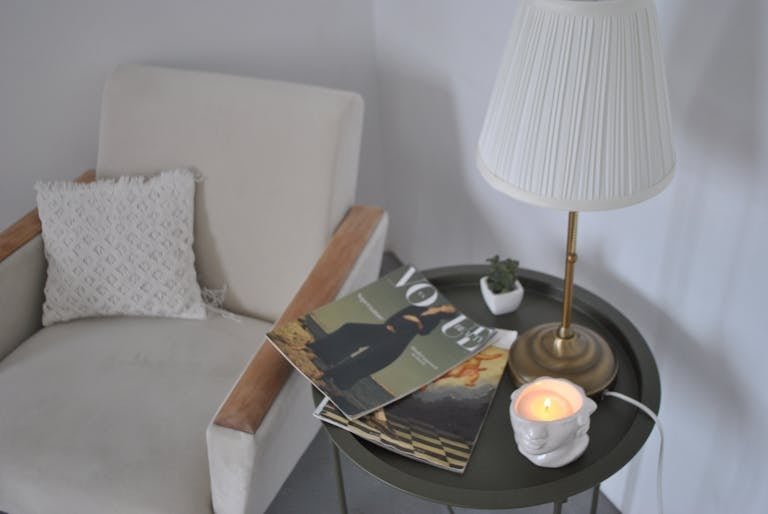
- Swap harsh overhead lighting for one or two warm lamps placed at eye level or below.
- Use warm, low-lumen bulbs (often labeled 2700K) instead of bright white.
- If you can, make one light your “last 30 minutes” lamp—the one you only turn on when you’ve already done your nighttime routine and you’re ready to wind down.
From a sleep-science perspective, dim, warm light supports melatonin, while bright, cool light and blue-heavy screens tell your brain to stay alert. You’re creating a miniature sunset inside your bedroom.
Sound: choose a gentle noise floor
Silence can be soothing—or unnerving.
- If your home is noisy, consider white noise or soft nature sounds from a dedicated device.
- If you live somewhere quiet, you might not need anything—but notice whether small sounds (a fridge, traffic, neighbors) jolt you awake.
The goal isn’t spa perfection. It’s “good enough” consistency so your body isn’t startled awake every 20 minutes.
Texture: make the bed a landing pad, not a workstation
Think less about perfectly matching sets and more about how your body feels when you lie down:
- One pillow that actually supports your neck, even if it’s not the prettiest
- A blanket weight that matches your climate (too hot or too cold both disrupt sleep)
- Natural fibers where possible—cotton, linen, wool—so your skin can breathe
This is a smaller, more intimate version of the work in Aesthetic Routine: Building Habits That Match Your New Identity: you’re letting your linens, lighting, and tiny details catch up to the way you want to feel at night, not the way your feed thinks your room should look.
Step 4: Build a Wind-Down Ritual That Competes With Your Phone
Removing screens is only half the story. If you don’t put something else in that last 30–60 minutes before sleep, your brain will go hunting for the old habit.
You need a ritual that feels easier and more rewarding than checking “just one more thing.”
A few ideas:
- One chapter of a physical book you actually want to read
- Gentle stretching on the bedroom floor
- Journaling for five minutes—one page of whatever is rattling around your mind
- Gratitude or reflection list: three things from the day you want to remember
- A short prayer or meditation if that’s part of your rhythm
If you’re not sure what would even fill that time, I put together a full guide to screen-free activities that actually feel good. You don’t have to overhaul your entire life—just steal one or two ideas and let them live in the bedroom.
The metric isn’t whether the ritual is impressive. It’s whether your body slowly learns: this is what we do here now.
Step 5: Make the System Work on Tired Nights
Design matters most on the nights when you feel least motivated.
Those are the nights when:
- You’re tempted to bring your phone to bed “just this once”
- You feel too drained to do your whole routine
- You want a shortcut to numbness, not one more thing to “optimize”
Build in safety nets for your exhausted self:
Lower the bar (on purpose)
Your only non-negotiable might be:
Phone charges outside the bedroom.
If you do nothing else—no stretching, no journaling, no elaborate skincare—but your phone sleeps in another room, you’ve still protected your sleep more than you think.
Create a “bare minimum” ritual
Decide what your 2-minute version looks like:
- Wash face
- Brush teeth
- Turn on lamp
- Read one page
You can always do more. But on the nights when you can’t, that tiny script is enough to keep the bedroom’s job description intact.
Let the room carry some of the work
Once your environment is set up—lamps, textures, no chargers, a book waiting—there will be nights when you walk in, feel the softness of the light, see the phone not on the nightstand, and realize you don’t actually want to undo all that work for another scroll tunnel.
That’s the quiet power of a real sanctuary: the space starts helping you keep the promises you’ve made.
Step 6: When You Share a Room, Have Kids, or Live Small
You might be reading this thinking, “Sure, but my reality is messier.”
Maybe you:
- Share a one-bedroom apartment
- Co-sleep with a baby or have a toddler who still crawls into your bed
- Sleep next to a partner who loves falling asleep to YouTube
A few gentle adjustments so the idea still holds:
If you share a room with a partner
- Have a conversation about the shared job of the room (rest and connection, not endless feeds).
- Agree on at least one shared boundary, like no phones in bed after a certain time.
- Create a designated surface—dresser, shelf, hallway table—where both phones charge overnight.
You won’t control another adult’s habits. But you can invite them into a shared experiment.
If kids wander in and out
- Keep the bedroom lighting soft and predictable so their nervous systems also learn “this is where we calm down.”
- Store one or two quiet, analog comforts within reach: a small stack of picture books, a soft toy, an extra blanket.
- If a monitor or baby-related screen lives in your room, treat it like a tool, not entertainment—no extra apps, no scrolling “while you watch.”
If your bedroom is also your office
Sometimes the only practical option is to work where you sleep. In that case:
- Contain your work in one visual zone (a small desk, a specific side of the room).
- At the end of the day, close the laptop, stack papers, and, if you can, cover that area with a scarf or screen.
- Give your bed and nightstand their own separate visual identity so your brain can still distinguish “work corner” from “sleep corner.”
You’re not aiming for perfection. You’re aiming for enough separation that your body doesn’t associate your pillow with spreadsheets and email.
When Your Bedroom Finally Stops Training You to Scroll
There will be a night—probably a small, unremarkable one—when you walk into your bedroom and feel something shift.
You’ll notice the lamp casting warm light on the sheets.
You’ll see your book waiting on the nightstand.
You’ll realize your phone is already in its “home” outside the room.
And instead of that restless urge to check something, you’ll feel a quieter pull toward the bed.
That’s the moment your bedroom stops being the last scroll station of the day and starts becoming what it was always supposed to be: a place where your body can land.
You don’t need a designer budget to get there. You need a few clear rules, some honest decisions about where your phone belongs, and a willingness to let this room become rich in the kind of stimulus that actually restores you—soft light, real rest, unhurried presence.
Over time, this one change won’t just improve your sleep. It will slowly reclaim the hours that used to disappear into a glowing rectangle, and return them to the part of your life that happens with your eyes closed and your phone nowhere in sight.