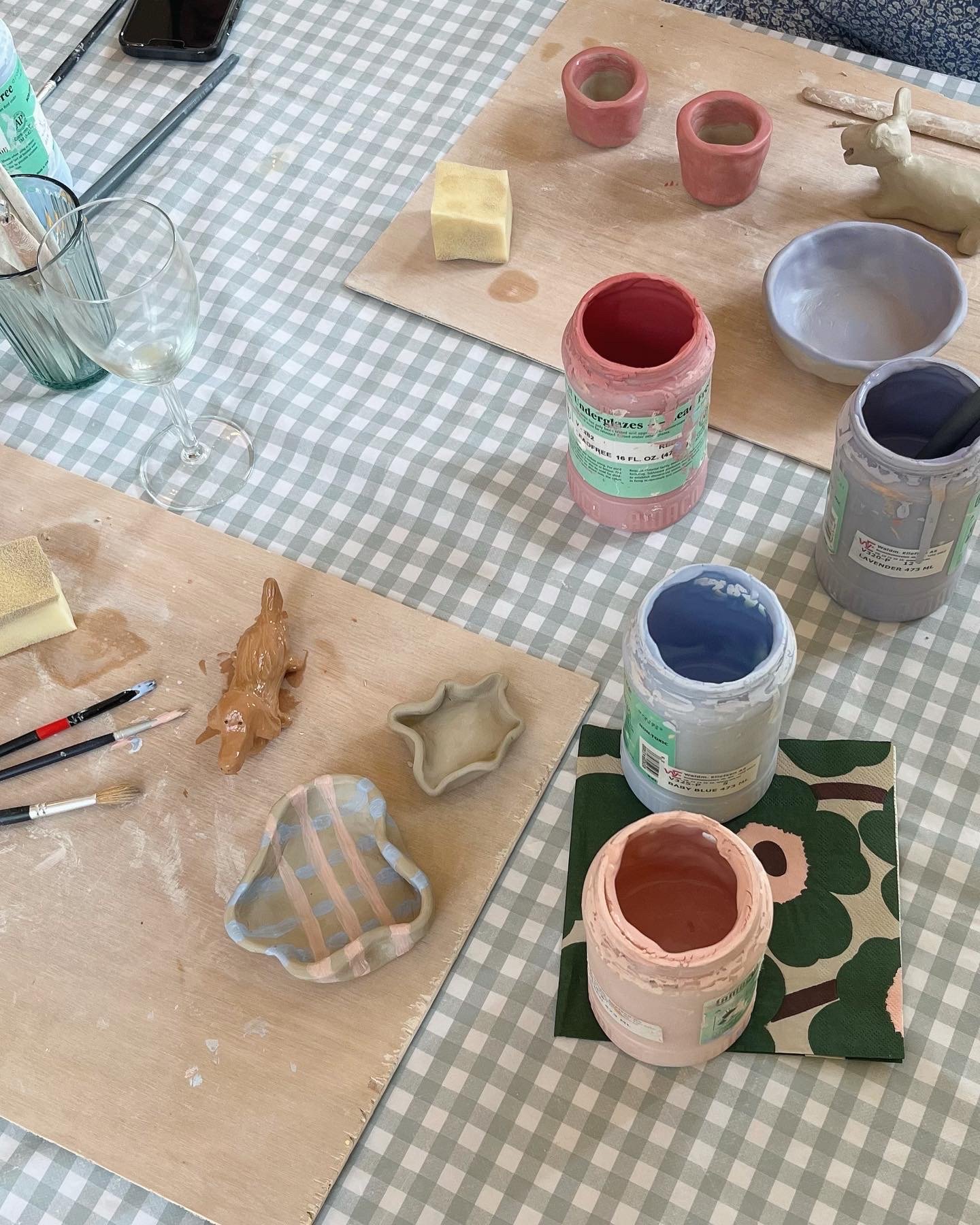
Hobbies for fun, not productivity. How to be delightfully bad at creative things at home — and why that’s exactly the point.
Picture a Tuesday night at home.
Dinner dishes are stacked in the sink, a candle is burning on the table, and instead of queuing up another show “for background,” you’ve pulled out a half‑dry set of paints, a slightly warped cutting board, or the guitar you only sort of know three chords on.
Nothing about this is impressive. The cookies might be flat, the sketch might be lopsided, the song might fall apart halfway through.
And that’s the point.
This is low-stakes creativity—a softer, messier creative era where the goal isn’t to monetize, post, or master anything. It’s to give yourself a place in your own home where you get to make things badly, lightly, and often.
In this piece, we’ll:
- Put clear language around what low-stakes creativity actually is
- Look at why it feels so good in a season obsessed with side hustles and aesthetics
- Set up simple containers so this stays playful instead of becoming another self-improvement project
- Give you concrete ideas you can try at home this week
By the end, you’ll have a handful of ways to be delightfully bad at things on purpose—and a home that quietly makes that easier.
Start Here: 10 Ways to Be Bad at Things This Week
Before we talk philosophy, let’s make this practical. Low-stakes creativity lives in tiny, repeatable scenes, not in grand creative overhauls.
Choose one or two of these to test in the next seven days:
- The five-song piano night. Pick five simple songs or chord progressions. Set a timer for 20 minutes. Stumble through them, laugh when you mess up, and resist the urge to “practice properly.”
- The wonky flower arrangement. Grab a grocery-store bundle and one or two stems from your yard or neighborhood. Arrange them quickly in a pitcher or jar—no Pinterest inspo, no tutorials. The job is “alive on the table,” not “gallery-level centerpiece.”
- The badly-drawn movie still. Pause a favorite film on a frame you love. Spend 15 minutes trying to sketch it with whatever pen and paper you have. The charm comes from how off it is.
- The experimental toast bar. Toast, butter, three toppings you already have. Make the strangest combinations you can think of. Declare the most delicious disaster the winner.
- The one-take voice note. Record yourself reading a poem, singing along to a song, or telling a story from your week. No re-recording. Delete it when you’re done or keep it just for you.
- The collage that never sees the internet. Rip pages from old magazines, mailers, or catalogs. Glue them into a notebook without overthinking composition. Bonus points if your hands get sticky.
- The “no-measurement” baking night. Choose a simple recipe you can’t ruin too badly (banana bread, muffins, a crisp). Loosely follow it, eyeballing a few ingredients. Enjoy the fact that it tastes like your version, not an exact replica.
- The messy letter writing session. Write short, imperfect notes to three people you love. No aesthetic stationery required. The bar is “it left your head and landed on paper.”
- The background soundtrack session. Put on an album you adore and doodle, knit, or do needlepoint without counting rows or tracking progress. Let your hands move at the pace of the music.
- The shared “let’s be bad at this” date. Invite a partner or friend to try something neither of you is good at—simple watercolor, karaoke at home, beginner chess, clumsy dancing in the living room.
None of these need a camera angle, a content plan, or a future product line.
They’re proof that your evenings can feel richer without turning every hobby into a highlight reel.
What Low-Stakes Creativity Actually Is
Low-stakes creativity isn’t laziness or a lack of ambition. It’s a deliberate decision to create a corner of your life where outcome doesn’t run the show.
A low-stakes creative practice:
- Has a tiny, clear job. “Make something for 20 minutes after dinner” or “play piano badly on Sundays” is enough.
- Doesn’t have to lead anywhere. No secret agenda to become a niche account, side hustle, or new identity.
- Welcomes inconsistency. You might touch it three nights in a row, then skip a week and come back.
- Values texture over polish. The point is how your life feels while you’re doing it, not how it looks from the outside.
If old-school hobbies have been calling your name—needlepoint, piano, flower arranging, vintage baking—think of low-stakes creativity as the gentlest entry point. You’re not committing to a full “old-school hobby era” (you already have a guide for old-school hobbies that make evenings feel richer). You’re simply giving yourself one tiny, charming skill or experiment to play with.
After Scroll exists to help you move from passive consumption to active construction of your life. Low-stakes creativity is one of the softest, most enjoyable ways to do that at home. It quietly supports:
- Structure: small, named pockets of time that invite making instead of scrolling.
- Habits: a rhythm where “I make a little something after dinner” becomes normal.
- Environment: corners of your home that are set up for play, not just for content.
- Relationships: evenings where you’re side by side doing something, not just co‑scrolling.
You’re not trying to become an artist overnight. You’re giving your current self more scenes where her hands are busy and her phone is somewhere else.
Why This Matters in a Side-Hustle World
For the last decade, we’ve been sold a story: if you’re good at something, you should monetize it. If you enjoy something, you should perfect it. If you pick up a hobby, you should at least be able to explain how it “fits your brand.”
The result? A lot of women with half-finished projects, abandoned hobbies, and an unconscious rule that anything worth their time has to earn its place.
Low-stakes creativity is a quiet rebellion against that logic.
When you:
- Let yourself be bad at watercolor and keep going anyway
- Bake a slightly lopsided cake and serve it with pride
- Play the same song badly on the piano for weeks because you like how it feels
…you’re telling yourself a different story about what your life is for.
Not every action has to be optimized. Not every hour has to produce proof.
This piece sits next to your gentle systems for finishing what you start without burning out. You still get to have projects that move all the way to done. Low-stakes creativity just makes sure that not everything you touch is under the pressure of being a finished thing.
It gives you a place to:
- Test ideas without commitment
- Remember what it feels like to play
- Let your identity breathe outside of performance and productivity
That relief you feel when you’re kneading dough, doodling in the margins, or humming along to an imperfect chord progression? That’s your nervous system responding to less evaluation and more presence.
Set Gentle Rules So It Stays Low-Stakes
Ironically, low-stakes creativity often needs a few soft rules so it doesn’t morph into another self-improvement project.
Think in containers, not goals:
- Time container: “Twenty minutes after dinner” or “one hour on Sunday afternoons.” If you’ve already created an analog hour at home where screens take a back seat, low-stakes creativity is a perfect thing to pour into that block.
- Effort container: “Good enough” is the metric. You stop when the timer goes off, even if the canvas isn’t finished or the bread isn’t perfect.
- Visibility container: Decide ahead of time what (if anything) ever leaves the room. Maybe 90% of what you make never hits the internet.
You can even borrow gentle boundaries from your digital wellbeing work:
- No progress photos during the session
- No Googling “how to get better at…” until you’ve done it badly at least ten times
- No turning the thing you’re testing into a content pillar or offer this season
If you want a deeper framework for choosing tactile projects that suit your season and energy, you already have a library of screen-free hobbies that actually stick for real life. Low-stakes creativity keeps the bar even lower: the hobby doesn’t have to “stick” yet. It just has to be allowed.
The rules aren’t there to box you in. They’re there to protect the softness of this space.
Let Your Home Make “Bad at Things” the Easy Choice
Habits are easiest when your environment is already on your side.
If your living room is set up exactly like every other scroll-happy room—chargers within reach, couch pointed at the TV, coffee table covered in remotes—it will always feel like a fight to choose paint, yarn, or piano keys instead.
A few small shifts borrowed from your phone + home work make a big difference:
- Create a little supply basket by the seat you actually land in at night—pens, a sketchbook, yarn, embroidery hoop, puzzle pieces.
- Clear one surface so it can become your “messy project” spot.
- Move chargers and default phone homes out of the immediate zone, following the same logic as your phone-free living room layout that actually feels inviting.
You can also think seasonally, the way you did with your spring bucket list and cozy, at-home rituals. Instead of filling every evening with outings, build a low-stakes, at-home creative era into your plans: a month where your bucket list is simply “try three ridiculous hobbies that never have to make sense to anyone but you.”
When you walk into a room and see:
- A puzzle in progress on the table
- A half-finished embroidery hoop on the arm of the chair
- A stack of cookbooks with sticky notes peeking out
…your home is quietly training you to reach for something real instead of for your phone.
A big menu of screen-free activities that already live inside your house can help on nights when you’re tired and can’t think of ideas. The point isn’t to do all of them. It’s to make sure something analog is always within arm’s reach.
How Low-Stakes Creativity Supports Your Nervous System
Part of why low-stakes creativity feels so good is that it gives your brain and body a different kind of input than scroll culture.
Instead of:
- Rapid, fragmented information
- Blue light late into the evening
- Constant micro-comparisons
…you get:
- Repetitive hand movements
- Real textures—paper, dough, wood, fabric
- Slower, more three-dimensional scenes
When your low-stakes creativity includes even a hint of movement—standing while you paint, dancing a little while you cook, walking to pick up flowers or ingredients—research from the Harvard T.H. Chan School of Public Health on why exercise boosts mood keeps showing that even modest movement layers in better energy and a lighter mood.
You don’t have to think about any of that while you’re in it. You just get to enjoy the feeling of your shoulders dropping a few millimeters while your hands are busy with something that asks nothing of you.
Let Relationships Be Playful, Not Performative
Low-stakes creativity isn’t only a solo project. It can be one of the easiest ways to shift your relationships from parallel scrolling to shared presence.
Think about:
- A weekly “bad at drawing” date where you and your partner each sketch the same object and swap pages.
- A Sunday “try a new cake” ritual with a friend—one of you bakes, the other brings coffee, no one cares what it looks like.
- A standing puzzle or collage table where roommates add a few pieces or scraps whenever they walk past.
You’re not hosting a perfect “creative night.” You’re inviting the people you love into scenes where no one has to be the expert.
This is where low-stakes creativity quietly strengthens your relationships:
- You practice seeing each other outside work, roles, and output.
- You build tiny, repeatable traditions that belong only to your home.
- You give your evenings a story that isn’t “we just scrolled next to each other again.”
Over time, these pockets of playful, imperfect making become part of how your home introduces you—to yourself and to the people who share it.
The Quiet Identity Shift of Being “Someone Who Makes Things (Badly)”
At some point, the details of what you’re making will matter less than the way you talk about yourself.
You’ll hear sentences like:
- “On Thursdays I do this silly watercolor ritual after dinner.”
- “I’ve been slowly learning this one song, not because I’m good at it, just because I like it.”
- “We’re in a season of trying charming little hobbies at home, none of which are going anywhere on the internet.”
That’s the deeper gift of low-stakes creativity.
You’re not collecting finished products for display.
You’re collecting proof that you are a person who makes things, tends to things, and plays—with no camera rolling.
You don’t have to declare this a new era or build a public narrative around it. You can quietly begin this week, with:
- One tiny, bad-at-it-on-purpose experiment
- One small change to a room so it invites more making
- One soft rule that protects this space from metrics and monetization
Let the rest unfold.