
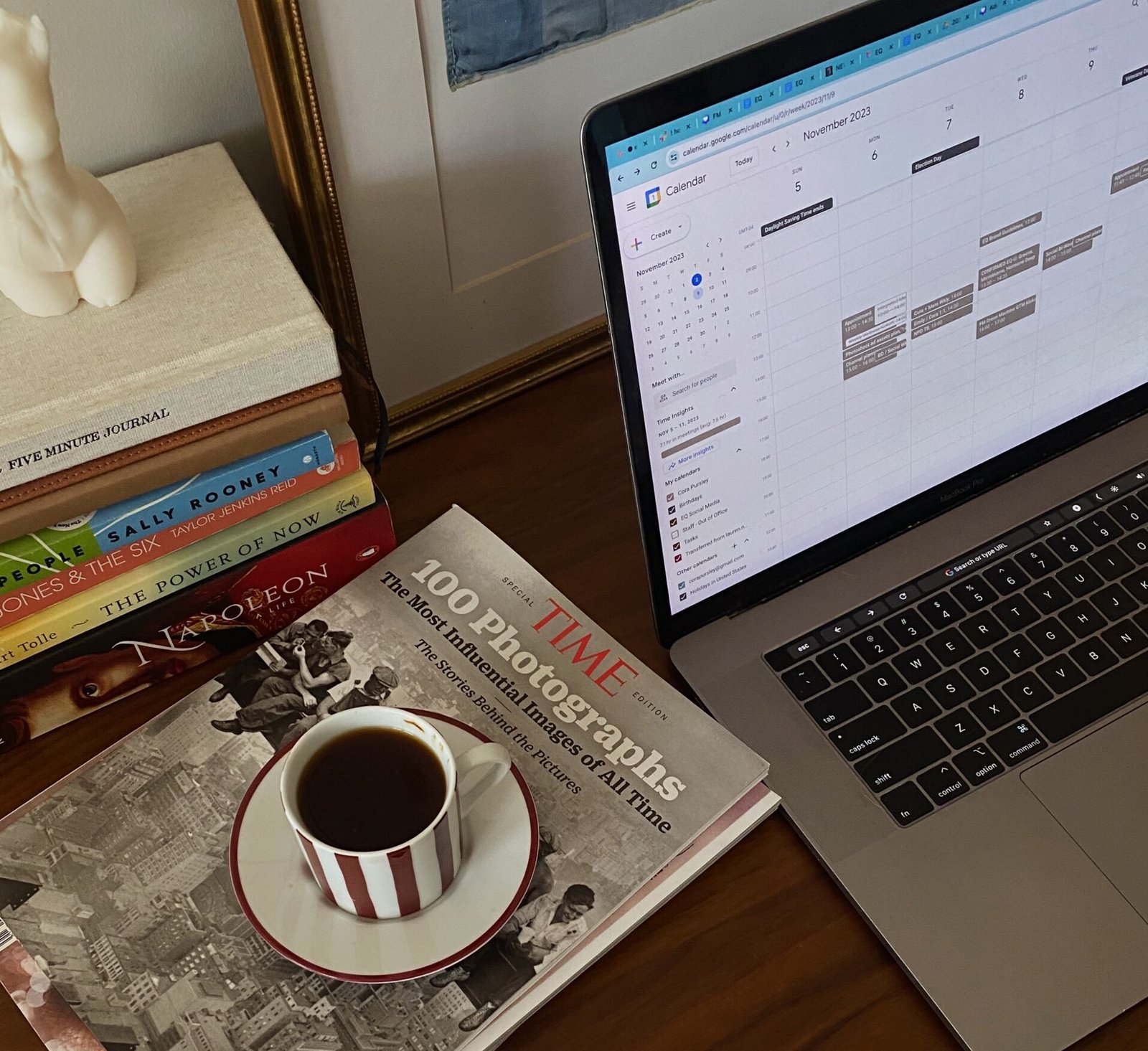
A good monthly planning routine makes the month feel held before it even begins.
Your calendar still has real life in it—appointments, work, school things, errands, people you love—but the month no longer feels like a pile of unrelated weeks. It has a direction. Your home gets attention before it becomes a problem. Your most important project gets space before urgency steals it. Ordinary days start feeling more intentional because they are serving something larger.
If you’ve been trying to figure out how to structure your month, this is the layer that usually changes everything. Weekly planning helps you stay steady. Monthly planning gives the week a bigger story.
Monthly planning routine: the quick start
If you want a simple version you can do in 15–20 minutes, start here:
- Choose one main focus for the month. Decide what you want this month to move.
- Mark the fixed dates first. Put appointments, travel, birthdays, and heavy weeks on the calendar before you plan anything ambitious.
- Pick one move for each life area. Choose one work focus, one home focus, and one life-admin or relationship focus.
- Give each week a role. Let Week 1 begin, Week 2 deepen, Week 3 carry the heavier pieces, and Week 4 finish and review.
- Make a not-this-month list. Protect your attention from every good idea that does not belong to this month.
That is enough to make a month feel different.
What is a monthly planning routine?
A monthly planning routine is a short ritual you use to decide what the month is for, what already belongs on the calendar, and what deserves your best attention before the weeks begin.
In practical terms, it helps you translate big intentions into a month you can actually live. Instead of hoping your priorities somehow fit between errands and notifications, you place them on purpose.
Why a monthly planning routine works so well
A month is a useful container because it is large enough to hold meaningful progress and small enough to stay real.
A week can move something. A month can shape something.
It can be the month you finally build a better dinner rhythm, reset the entryway, finish the draft, book the appointments, or make your mornings feel less scattered. I like thinking of a month as having a personality. Not a list of ten goals. A clear tone.
That is also why this planning layer fits so naturally with a slower, more sustainable way of working. You are not trying to do everything at once. You are choosing fewer things, placing them honestly, and letting them compound.
Step 1: Give the month one clear job
Before you open your calendar, decide what you want this month to mean.
Ask:
At the end of this month, what would make me feel pleased with how I spent it?
Your answer might sound like this:
- We ate at home in a calmer way.
- I moved one meaningful work project instead of touching six.
- The house started helping me instead of distracting me.
- I stopped letting my evenings disappear into my phone.
- I handled the practical things that have been hovering.
From there, choose:
- one main focus
- one or two support themes
For example:
- Main focus: structure work better
- Support themes: simplify dinners + make evenings more phone-light
This is the monthly version of giving the week a clear job. The same logic behind weeks that already know what they are responsible for works beautifully at the monthly level too.
Step 2: Put the fixed dates down before you plan the ideal month
This is where your monthly planning routine becomes useful instead of decorative.
Open the calendar and mark what is already true:
- appointments
- birthdays and holidays
- travel
- school events
- deadline-heavy weeks
- weekends that are already full
Now ask:
Where is this month already spoken for?
That question changes the tone of planning immediately.
A month with guests, travel, and two deadline-heavy weeks can still be lovely and productive. It just needs a different shape. It may be the month for one meaningful project and a simpler home rhythm. That kind of honesty is elegant. It keeps you from planning against your actual life.
As Harvard Business Review’s advice on aligning your time with your goals makes clear, priorities only become real when time is deliberately matched to them.
Step 3: Choose what will move in work, home, and life admin
One reason monthly planning works so well is that it keeps your goals attached to real life.
Instead of one giant abstract ambition, choose one movement point in the categories that shape your days.
Work or production
Pick one result that would make the month feel genuinely productive.
For example:
- draft four posts
- finish the proposal
- clean up one workflow
- update your portfolio
- finally send the email you keep postponing
The key is to make it concrete enough that you can recognize it when it happens.
Home or environment
Choose one improvement that would make your days easier to live inside.
For example:
- reset the pantry
- organize the entryway
- create a better landing spot for bags and paper
- make the bedroom feel more restful
- set up one corner that supports focused work
This is often where the month starts to feel more supportive. Your environment either reduces friction or keeps adding it.
Habits, relationships, or life admin
Choose one rhythm or practical task that deserves a real place this month.
For example:
- a weekly dinner plan
- one standing walk every weekend
- schedule the overdue appointments
- sort the budget
- plan one dinner with friends
These are the kinds of small decisions that stop a life from feeling fragmented.
And once you choose them, it becomes much easier to support them with short finish sessions that actually help things get done and tiny habits that quietly build trust with yourself.
Step 4: Map the month into weeks before the month begins
This is the part most people skip when they are learning how to structure your month.
A good monthly planning routine does not stop at a list of intentions. It turns the month into weeks.
Look at the calendar and ask:
- Which week is best for the main project?
- Which week needs to stay lighter?
- What should happen early so the month does not drift?
- What can wait until later because it does not need prime energy?
Then give each week a loose role.
For example:
- Week 1: set up and begin
- Week 2: make real progress
- Week 3: handle the heavier practical pieces
- Week 4: finish, review, and reset
That is when your weekly planning becomes dramatically easier. You are no longer asking every Monday to invent meaning from scratch.
If you work from home or your days hold multiple roles, this gets even more valuable. A month with week-level roles supports a calmer work-from-home rhythm because each week already knows what it is carrying.
Step 5: Add one repeatable rhythm that supports the month
Every good month has a support beam.
Ask:
What repeated action would make this month easier to keep?
If the month is about work, that rhythm might be:
- a Monday planning block
- two focused sessions each week
- one protected morning for your most important task
If the month is about home, it might be:
- a Thursday evening reset
- a Saturday project window
- a weekly fridge and meal-plan refresh
If the month is about calmer attention, it might be:
- a more phone-light first hour
- a small evening reset that prepares tomorrow
- one analog pocket each weekend
This is where supporting habits matter. Often the month feels better not because of one heroic push, but because of a few repeated moves. A more phone-light start to the day and a short evening setup that makes tomorrow easier can quietly hold far more of the month than people expect.
Step 6: Make a not-this-month list
This may be the most useful part of a monthly planning routine.
Once you decide what the month is about, decide what it is not about.
Write down the ideas that keep opening tabs in your mind:
- the course you might take later
- the room you want to redo next season
- the side project that matters but is not timely
- the habit that sounds appealing but is not the next right one
A not-this-month list gives your month clean edges.
That matters more than it seems. Research highlighted by the American Psychological Association on progress monitoring shows that people are more likely to reach goals when they keep progress visible. One of the easiest ways to keep progress visible is to stop hiding your real priorities under everything else you could do.
How to start your monthly planning routine today
If the next month feels too far away, you can still start now.
Try this short reset tonight:
- Look at the next four weeks on your calendar.
- Circle the weeks that are already heavy.
- Write one sentence that begins: “This month is for…”
- Choose one work move, one home move, and one life move.
- Decide one weekly rhythm that will support all three.
If you want to make it even easier, turn those decisions into tiny if-then plans. A classic PubMed review on implementation intentions shows that behavior becomes easier to follow through on when you decide in advance what you will do and when you will do it.
That can be very simple:
- If it is Sunday afternoon, then I review the month ahead.
- If it is Thursday evening, then I reset the kitchen and plan dinners.
- If Monday morning feels scattered, then I choose the one task that moves the month.
This is the kind of structure that feels graceful in real life.
Quick recap: how to structure your month
If you want the short version, here is the monthly planning routine again:
- Decide what the month is for.
- Mark the fixed dates first.
- Choose one move in work, home, and life admin.
- Turn the month into week-level roles.
- Add one repeatable support rhythm.
- Make a not-this-month list.
- Review the month simply enough that you will do it again.
A good month rarely comes from intensity.
It comes from perspective.
You see what matters, place it honestly, support it with rhythm, and let the rest wait its turn. Over time, that is how a month stops feeling like a blur and starts feeling like something you actually shaped.