There is a particular pleasure in reaching the part of the evening where the lamp is on, the room is a little quieter, and a book finally gets to be the main event. Not background noise. Not “content.” Just pages, ideas, and the slow feeling of giving your mind somewhere deeper to go.
If reading has started to feel strangely hard—even when you genuinely want to do it—that does not mean you have become a shallow person or that books are no longer for you. It usually means your attention has been trained by faster rewards than books are designed to give.
I have noticed this in my own life too: when my phone is the easiest object in the room, even a book I am excited about can start to feel oddly demanding. The good news is that reading comes back much faster than people think once you stop treating it like a discipline problem and start rebuilding the conditions that make it possible.
This is a guide to doing exactly that: how to read books again in a real, modern life where your brain has grown used to scrolling, checking, skimming, and switching.
Start here: 5 changes that make reading possible again
Before we get into the deeper why, start with these five shifts. They are small, practical, and they work.
- Pick one book and make it visible. Not a stack. Not a seasonal TBR. One book. Leave it on the chair, side table, or pillow where you usually land.
- Keep your phone in a different room for the first 15 minutes. If your hand can reach your phone without effort, your brain will usually choose it before the book has a chance to get interesting.
- Read earlier than you think you should. A lot of women keep trying to read at the very end of the day, when they are already mentally spent. Try reading right after dinner, during your tea break, or inside one protected analog pocket in the evening instead.
- Lower the bar dramatically. Read five pages. Ten minutes. One short chapter. The goal is not to impress yourself. The goal is to make reading feel normal again.
- Build a spot that quietly competes with your phone. Even one chair, one lamp, and one open book can shift the whole mood of an evening. A reading corner that your body starts associating with pages instead of feeds makes more difference than another promise to “be more disciplined.”
If you did only these five things for the next two weeks, you would already feel your reading life changing.
Why reading feels harder than it used to
Books ask your mind to do something scrolling does not: stay.
Stay with one voice. Stay with one idea long enough for it to unfold. Stay through the first few pages before the real texture arrives. Stay when there is no instant reward every seven seconds.
That can feel harder now not because you are worse at reading, but because your brain has been rehearsing a completely different rhythm.
Scrolling trains you for speed, novelty, interruption, and micro-reward. Even when the content is mediocre, the next swipe promises something new. That variable reward loop is hard for almost anything analog to compete with.
The American Psychological Association’s overview of how task-switching drains focus helps explain why this matters. When you keep toggling between messages, tabs, apps, and tiny bits of information, your attention does not fully settle. It keeps hovering.
And that hovering state is almost the opposite of what books require.
Research also suggests that screens can be a tougher medium for sustained comprehension, especially when attention is already under pressure. This PubMed summary on reading medium and time pressure points to something many of us can feel in real life: when your brain is hurried and overstimulated, reading on screens can invite more mind-wandering and shallower focus.
So if you have been wondering why you can read captions, newsletters, texts, and article fragments all day but still struggle to sink into a book, the answer is not that your attention is gone forever. It is that it has been trained for velocity.
Books are asking for depth.

Reading asks for a slower kind of pleasure
One reason so many women say they “want to read more” is that reading offers a kind of pleasure the internet cannot.
Not louder pleasure. Not faster pleasure. Better pleasure.
Reading gives you:
- a fuller interior life
- a calmer evening rhythm
- better language for your own thoughts
- real ideas to carry into conversation, work, motherhood, friendship, and your sense of self
It also changes the texture of your days. A woman who reads regularly moves through her life a little differently. She has a private world that is not entirely shaped by whatever the algorithm served this week.
That matters.
After Scroll has always been about building a life that feels richer than your screen. Reading fits that vision beautifully because it supports so many of the pillars underneath it: structure, habits, environment, and even relationships. A reading life gives shape to evenings. It gives your home a quiet purpose. It gives you something real to think about, not just react to.
And once you feel that again, reading stops being a self-improvement goal and starts becoming part of the kind of life you actually want to live.
Make reading the easiest interesting thing in the room
If your evening environment is still arranged around scrolling, reading will keep losing by default.
This is why so much advice about “reading more” falls flat. It assumes the book and the phone are meeting on neutral ground. They are not.
Your phone is charged, bright, familiar, and engineered to remove friction. If you want books to win more often, your space has to help them.
A few things that work especially well:
- Keep your current book open to your page instead of closed in a stack.
- Move your charger away from your best evening seat.
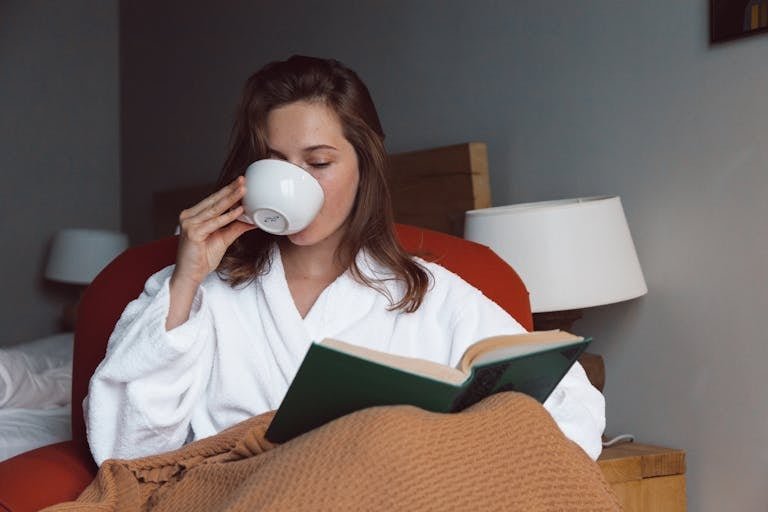
- Put a lamp, blanket, and drink within reach so the first 30 seconds of reading feel easy.
- Let your living room support quieter habits instead of constant checking. If that room still defaults to the couch-phone-TV loop, this guide to creating a living room that feels more inviting than your feed is a strong companion.
- If space is tight, remember that one square meter is enough. These small-apartment reading nook ideas prove that you do not need a picture-perfect library corner to build a reading life.
What you are doing here is simple: making the book the easiest interesting thing in the room.
That one sentence changes so much.
Because once the room stops advertising your phone and starts advertising pages, your brain no longer has to do all the work alone.
Give your attention a smaller runway
A lot of women try to get back into reading by setting a very ambitious version of the habit.
They buy a long literary novel. They imagine an hour every night. They picture themselves becoming the sort of woman who naturally reads forty books a year.
There is nothing wrong with that woman. But she is not where you start.
Start with a version of reading your current brain can actually say yes to.
Try one of these:
- Ten-minute reading starts. Set a short timer and stop while it still feels pleasant.
- One chapter before screens. Not instead of screens forever—just before them.
- Read during a transition. After work, after dinner, before bed, before anyone else wakes up.
- Pair reading with a ritual. Tea, a lamp, music low in the background, one specific chair.
This is why an intentional analog hour can be so useful. It gives reading a container. Instead of asking yourself all evening whether you are “in the mood” to read, you create one pocket of time where books are simply one of the obvious things to do.
The smaller the runway, the easier it is for your attention to take off.
And once it does, you will often read longer than you planned—not because you forced yourself, but because the book finally had a chance to become more compelling than the phone.

Choose books for your current brain, not your fantasy self
This might be the most underrated advice in the whole conversation.
If you are relearning how to read books again, do not begin with the most difficult book on your shelf just because it makes you feel virtuous.
Begin with something that creates momentum.
That might be:
- a novel with immediate narrative pull
- essays you can read in one sitting
- memoir that feels intimate and easy to enter
- nonfiction with short chapters and a strong voice
- a book you have already read before and know you love
You are not cheating if you choose an easier book.
You are rebuilding trust.
It can help to think in three lanes:
- Pleasure books — easy to enter, genuinely enjoyable, the kind you look forward to.
- Nourishing books — deeper, slower, more reflective, but still welcoming.
- Stretch books — the ones that ask more of you and that you save for when the habit is already alive again.
This is much more effective than forcing yourself through a book you “should” want to read and then deciding the problem is you.
Reading is a relationship. Let it become warm again before you make it difficult.
Replace the tiny urge to check your phone
One of the hardest parts of reading after a long season of scrolling is not the reading itself. It is the tiny urge to interrupt it.
You read two pages, hit a slightly slower paragraph, and suddenly you want to check a text, look something up, or “just see” what is happening on your phone.
That moment matters.
Sometimes the best move is simply distance: phone in the kitchen, not next to the chair.
Sometimes it helps to give your brain another small reward nearby:
- tea or sparkling water
- a pen for underlining or margin notes
- a blanket or candle that makes the ritual feel good
- a short list of pleasant alternatives for the nights when you are too mentally tired for pages
That is where something like a simple menu of analog rewards can help. Reading does not have to be the answer every single time you want less scrolling. But it becomes much easier to choose on the nights when the rest of your environment is already nudging you back toward the real world.
And if the bigger issue is still compulsive phone use, it is worth revisiting a more complete reset of the scrolling habit itself. Reading often returns more easily once the all-day drip of attention-fragmentation starts to calm down.
Let reading become part of the life you are building
The deepest reason to read more is not that it sounds admirable.
It is that reading makes life feel fuller.
A woman who reads has more mental room. More language. More references. More private thought. More patience for slower pleasures. More companionship in the quiet parts of life.
And that changes things far beyond the pages.
It changes how you spend a rainy evening. How you decorate a corner of your home. How you travel. How you talk at dinner. How you think about your own work. How you move through a season where you are trying to become more present, more thoughtful, more rooted in what actually matters.
That is why this belongs so naturally inside a slower, more intentional life. If you have been craving a life that feels less reactive and more textured, slow living in the real-world sense is not about doing nothing. It is about choosing rhythms that let your mind and home become places you can actually inhabit.
Reading is one of the loveliest ways to begin.
What to expect when your reading life starts coming back
At first, reading may still feel a little restless.
You may notice yourself rereading paragraphs. Wanting more stimulation. Feeling surprised that ten quiet pages can feel harder than forty minutes of skimming.
That is normal.
Keep going anyway.
Because then something beautiful tends to happen: your mind starts remembering the pace of books. The first pages stop feeling slow. Your body learns the ritual. The chair, the lamp, the chapter, the quiet—all of it begins to feel familiar again.
And one night, without much drama, you will realize you have been reading for twenty or thirty minutes without wanting to escape.
That is the turning point.
Not because you have become a different person overnight, but because you have gently retrained your attention toward something worth keeping.
If you have been missing the woman who could disappear into a book, she is probably not gone.
She may just need a softer room, a smaller first step, and a little less scrolling between her and the page.